MindAptix | AI-Powered Development Agency

Uncover proof of MindAptix impact across 3000 + digital deliveries for 35+ industries. EXPLORE NOW! Uncover proof of MindAptix impact across 3000+ digital deliveries for 35+ industries. EXPLORE NOW!
Uncover proof of MindAptix impact across 3000+ digital deliveries for 35+ industries. EXPLORE NOW! Uncover proof of MindAptix impact across 3000+ digital deliveries for 35+ industries. EXPLORE NOW!

January 2026

AI Use Cases That Actually Deliver ROI (Not Just Buzzwords)

AI Use Cases That Actually Deliver ROI (Not Just Buzzwords)

Every week, another business labels itself “AI-powered.” Products boast “smart automation,” and agencies promise “next-gen solutions But when business owners sit across the table from me, they ask a simple question: “Will this actually make us more money, save us time, or solve real problems?” That question matters. Because AI that sounds impressive but delivers no measurable impact is not innovation. It is noise. At MindAptix Technologies, we have worked with startups, growing companies, and enterprises who were burned by overpromised AI projects. We’ve also seen what happens when AI is built with clarity, purpose, and strong engineering behind it. The difference between hype and ROI is not technology. The difference is strategy, execution, and understanding business realities. This article is not about trends. It is about real AI use cases that are producing measurable results across industries. Why Most AI Projects Fail to Deliver ROI Before diving into successful use cases, it’s important to understand why many AI initiatives quietly fail. Not because AI doesn’t work. But because: Teams build features instead of solving problems Leadership chases trends instead of business outcomes Data foundations are weak AI is added too late, instead of being part of product strategy Agencies sell demos instead of scalable systems That’s why companies today are no longer impressed by “AI-enabled.” They want revenue impact, cost reduction, operational efficiency, and better customer experience. This is where experienced AI software development services matter. 1. AI in Ecommerce Mobile App Development That Increases Revenue One of the strongest real-world ROI drivers is AI inside ecommerce platforms. Smart ecommerce mobile app development today goes beyond product catalogs. When built properly, AI directly impacts conversion rates and customer lifetime value. Real use cases delivering ROI: Personalized product recommendations based on behavior Dynamic pricing based on demand and user segments Smart search that understands intent, not just keywords AI-powered upselling and cross-selling Cart abandonment prediction with targeted offers We worked with ecommerce founders who saw: 28–45% increase in average order value 22% higher repeat purchases Significant drop in bounce rate This isn’t magic. It is thoughtful AI applied to real buying behavior. This is why serious brands partner with a best mobile app development company in India that understands both business psychology and technical architecture – not just code. 2. AI for Business Mobile App Development That Reduces Support Load Customer support is expensive. Human agents burn out. Customers get frustrated. AI-driven business mobile app development solves this when done properly. Not with generic chatbots that repeat scripted answers. But with intelligent systems trained on actual customer conversations. High-ROI examples: AI support assistants handling 60–70% of Tier-1 queries Smart onboarding that guides users contextually Predictive help suggestions inside the app AI detecting frustration signals and escalating to humans One SaaS client reduced support tickets by over 40% within 3 months. That is real operational ROI. Good AI doesn’t replace humans. It protects them from repetitive work so they can handle meaningful conversations. 3. Custom Enterprise Software Development with Predictive Intelligence Enterprises often sit on massive amounts of data. Sales pipelines, operational data, employee workflows, customer behavior. But most of it goes unused. This is where custom enterprise software development integrated with AI becomes transformational. Examples we see working consistently: Sales forecasting models improving pipeline accuracy AI-based lead scoring for higher conversion Predictive maintenance systems reducing downtime Workforce productivity insights Fraud detection systems for finance platforms One logistics company reduced delivery delays by over 30% after implementing AI-driven routing intelligence inside their internal system. That’s not buzz. That’s profit impact. When done right, custom enterprise software development becomes more than automation. It becomes a decision engine for leadership. 4. AI in Website App Development Services That Improves Conversions Many companies invest heavily in traffic. SEO. Paid ads. Content. But their websites and apps still underperform. AI-enhanced website app development services change this. Real impact areas: Behavioral heatmap intelligence to adjust layouts dynamically Smart personalization of landing pages AI-generated content suggestions for better engagement Predictive exit intent offers Adaptive onboarding flows Instead of static user experiences, AI creates experiences that adjust in real-time. We’ve seen B2B websites increase qualified leads by over 35% simply by implementing behavioral personalization correctly. The difference is not flashy visuals. The difference is intelligence applied to user intent. 5. AI in Operations: Saving Time, Not Just Adding Features Many founders think AI is only for products. The real hidden ROI often lies inside operations. Strong AI software development services help internal teams: Automate document processing Summarize meetings and action points Analyze internal reports faster Optimize workflows Reduce manual approvals Speed up recruitment screening One HR-tech client reduced manual resume screening time by 70% using AI scoring. That freed their team to focus on actual candidate quality. These are quiet improvements. But they compound month after month into massive savings. 6. AI for Decision-Making, Not Guesswork Leaders today face constant pressure to make fast decisions with incomplete data. AI can support this when built responsibly. Practical examples: Dashboards with predictive insights instead of static charts Revenue projections based on historical behavior Customer churn risk detection Market pattern recognition Pricing optimization models Executives don’t want more dashboards. They want clarity. This is where strong custom enterprise software development combined with AI delivers leadership-level ROI. 7. Why Businesses Trust Experienced Teams Over “AI-First” Agencies Every week, new agencies label themselves as “AI companies.” But very few understand architecture, scalability, security, data ethics, and product strategy together. Serious businesses partner with teams that: Understand domain deeply Design systems for long-term scalability Respect data privacy Communicate transparently Build measurable milestones Think beyond MVP That’s why companies looking for the best mobile app development company in India are no longer searching for cheap developers. They are searching for strategic technology partners. MindAptix Technologies works at that intersection – where engineering discipline meets business understanding. The Human Side of AI That Most Blogs Ignore Let’s be honest. Founders worry: “Will my team accept this?” “Will this break trust with customers?” “Will this damage

AI Use Cases That Actually Deliver ROI (Not Just Buzzwords) Read More »
Flutter vs React Native vs Native Apps

Flutter vs React Native vs Native Apps: A Business View (No Fluff, Just Reality)

Almost every week, I talk to founders who bring up the same concern: “Do we build this with Flutter, React Native, or go fully native?” It’s rarely about passion for technology. It’s about real pressure – budgets, deadlines, investor expectations, and the fear of getting the decision wrong. That fear is understandable. One poor technology decision at the beginning can slow progress for months, sometimes even longer. This conversation isn’t about code. It’s about business impact. First, let’s be honest about how this decision usually goes wrong Most people choose technology for the wrong reasons: A friend recommended it A developer is comfortable with it A blog post said it’s trending Another startup used it The agency pushed their favorite stack That’s not strategy. That’s convenience. A serious app development company doesn’t start with frameworks. It starts with uncomfortable questions: What are you building? Who will use it? What happens if this works? What happens if it fails? The answers shape the technology, not the other way around. Native apps: powerful, expensive, and sometimes overkill Native apps are built separately for Android and iOS. That means two codebases, two teams, more complexity. Let’s talk about where native truly shines. If you’re building: A fintech app that handles sensitive transactions A product deeply tied to device hardware A performance-heavy app (like real-time systems or gaming) Something that must scale for millions of users Then yes, native development often makes sense. Many enterprise-grade products still rely on native because the control is unmatched. But here’s what people don’t like admitting: A lot of startups choose native because it “sounds premium”, not because they actually need it. They burn budget too early, slow their release cycle and struggle to maintain two platforms. Sometimes native is the right choice. Sometimes it’s just an expensive badge of seriousness. React Native: practical, fast, but not magic React Native exists because businesses wanted speed without building everything twice. When done well, mobile app development with React can be incredibly effective. A good react native app development company can help you: Launch faster Test ideas without huge investment Push updates quickly Maintain one shared codebase Keep early costs under control That’s why many startups rely on react native app development services for MVPs, SaaS products, marketplaces, and internal tools. But here’s the part people don’t say publicly: React Native built by weak teams becomes fragile very quickly. Too many plugins. Too little structure. Messy state management. Performance issues that appear six months later. React Native itself is not the problem. Poor engineering is. Flutter: where many modern products are heading Flutter is interesting because it didn’t become popular through hype alone. It became popular because it solved real problems teams were facing. One codebase. Strong UI control. Solid performance. Faster development. Consistency across platforms. For startups and growing SaaS products, Flutter often hits a very practical balance. Many founders working with a reliable saas development company now lean toward Flutter because it supports speed without sacrificing too much technical structure. Is Flutter perfect? No. But for the majority of business apps today – dashboards, booking platforms, learning apps, marketplaces, logistics tools – Flutter works extremely well when handled by mature engineers. The uncomfortable truth about cost Let’s speak plainly. Native = most expensive Flutter = mid-range React Native = usually similar to Flutter But cost is not just about development. It’s about maintenance. Two native apps cost more to: Update Test Debug Scale Support Cross-platform solutions reduce that burden. That’s why many founders prefer Flutter or React Native until their product reaches a scale where native investment makes strategic sense. This is how the best app development companies think: not about today’s invoice, but about next year’s technical health. Speed matters more than perfection in early stages Most successful products did not launch perfect. They launched early, learned quickly, and improved continuously. That’s why speed often matters more than architectural purity in the beginning. React Native supports quick iterations Flutter supports fast UI changes Native often slows experimentation A practical app development company understands this and helps founders balance momentum with quality instead of blindly chasing technical purity. SaaS founders usually care about three things After working with many SaaS products, a pattern becomes obvious. Founders care about: Can we ship updates fast? Will this break when users grow? Are we wasting money unnecessarily? That’s why many SaaS founders choose Flutter or React Native when working with an experienced saas development company. It gives them room to grow without locking them into expensive infrastructure too early. Frameworks don’t ruin products. Decisions do. Bad architecture ruins products. Rushed decisions ruin products. Poor communication ruins products. Inexperienced developers ruin products. I’ve seen scalable systems built in Flutter. I’ve seen fragile systems built in native. The difference was always the team, never just the tools. This is why choosing the right app development company matters more than choosing the “right framework”. Real-world examples (the kind founders relate to) A bootstrapped founder building their first product → React Native or Flutter makes practical sense. A funded startup building fintech infrastructure → Native often makes sense. A SaaS founder planning mobile + web ecosystem → Flutter fits nicely. A marketplace experimenting with business model → React Native keeps things lean and flexible. This is the thinking process used by mature teams among the best app development companies. What users actually care about (hint: not your tech stack) Users care about: Does the app feel smooth? Is it confusing? Does it crash? Does it solve their problem? They don’t care how it’s built. They care how it feels. A well-built Flutter app feels better than a poorly built native app. A well-built React Native app feels better than a rushed Flutter app. Execution always beats framework choice. Final thought (the part most agencies won’t tell you) The right question isn’t: “Should we use Flutter, React Native, or native?” The real question is: “Do we have a team that understands product, architecture, growth, and

Flutter vs React Native vs Native Apps: A Business View (No Fluff, Just Reality) Read More »

validate an app (2)

How to Validate an App Idea Before Investing Money

Every week, someone spends their savings on an app that never gets used. Not because they lacked passion. Not because the idea was bad. It usually fails for one simple reason: nobody checked whether real users actually wanted it. Validation is not a formality. It’s the difference between building a business and building regret. If you’re thinking about investing in mobile app development, whether for a startup idea or a business expansion, this step matters more than design, tech stack, or feature list. Without validation, everything else becomes guesswork. This guide is written from real-world experience – the kind of thinking strong product teams and practical partners like MindAptix bring to the table when shaping apps that stand a real chance in the market. Great Ideas Often Fail Without Proof On paper, many ideas sound brilliant. In reality, users behave very differently than founders expect. People say they like concepts. They rarely commit to using them. That’s why experienced app programming companies never jump straight into development. They push for clarity first: Who exactly is this for? What pain does it solve today? How urgent is that pain? What happens if your app never existed? If the answer to that last question is “nothing much,” you have a serious risk. Think Like a User, Not Like a Founder Founders see features. Users feel friction. Instead of listing what your app will do, describe the moment your user is struggling. Picture their day. Where does the problem occur? What emotion is attached to it – stress, confusion, wasted time, financial loss? A business planning ecommerce app development might assume users want more filters, more categories, more recommendations. Real users often want fewer steps, faster checkout, and honest delivery timelines. Empathy shapes better products than assumptions ever will. Conversations Beat Surveys Every Time Online surveys give shallow answers. Real conversations give insight. Speak directly with people who match your target audience. These shouldn’t feel like interviews. They should feel like honest discussions. Good questions sound like: Tell me about the last time you faced this issue What annoyed you the most about that experience? What solutions have you tried already? Why didn’t those work well enough? Listen more than you talk. Patterns will start appearing quickly. Those patterns tell you what to build – and what to avoid. Serious mobile app development begins here, not in Figma. Validate Interest Before Building Anything You don’t need an app to test whether people care. You need a clear message and a simple page. A basic landing page can communicate: The problem Your proposed solution Why it matters A signup form for early access Share that page wherever your audience already spends time. Track how many people actually join the waitlist. Silence is feedback. So is excitement. Many successful founders validated ideas this way long before hiring app programming companies. Run Small Paid Campaigns to Measure Real Demand Emotions lie. Data doesn’t. Instead of spending lakhs on development, spend a small amount on ads. Send traffic to your landing page. Watch what happens. Pay attention to: How many people click How many stay on the page How many sign up How many return later This gives you a realistic signal about demand. If nobody responds, it’s not a failure – it’s valuable information. This approach saves businesses from investing prematurely in mobile app development that has no market. Prototypes Reveal Problems Early A clickable prototype can reveal issues that wireframes and feature lists hide. You can simulate an app experience using simple design tools and let potential users interact with it. Ask them to perform basic tasks. Watch where they hesitate. Notice where they get confused. Their behavior will teach you more than any brainstorm session ever could. For teams working on custom iOS app development, this step often prevents expensive rework later. Competitor Research Should Focus on Weaknesses Competition is not a threat. It’s evidence that people care about the problem. Instead of fearing competitors, study them carefully: Read user reviews Pay attention to complaints Look for missing features Notice pricing frustrations Observe usability problems Negative reviews often contain more product insight than positive ones. This is especially useful in crowded spaces like ecommerce app development, where differentiation comes from solving what others ignore. Sell the Value Manually Before Automating It You can validate many ideas without building any software at all. Offer the service manually first: Manage bookings through WhatsApp Take orders using Google Forms Run scheduling through spreadsheets Deliver consulting through Zoom If users stay engaged, respond consistently, and value the service even when it’s manual, that’s a strong signal. If they disappear quickly, an app would not fix the underlying issue. This method has saved countless founders from wasting money on unnecessary mobile app development. Compliments Are Meaningless Without Action People will tell you your idea is “nice.” That doesn’t mean they will use it. Validation comes from behavior: Will they give you their email? Will they refer someone else? Will they return to your page? Will they pay even a small amount? Commitment matters. Politeness doesn’t. Strong app programming companies measure traction, not praise. Pricing Feedback Should Come Early Pricing is part of validation, not something to worry about after launch. Ask directly: What would feel fair to pay for this? Would you prefer monthly or one-time payment? What price feels too expensive? What price feels suspiciously cheap? The answers won’t be perfect, but patterns will guide better decisions. This matters especially in custom iOS app development projects where monetization needs clarity from day one. Trust Is Part of Validation People don’t just validate ideas. They validate you. When users trust the creator, they engage more honestly and commit more seriously. Ways to build credibility early: Share insights publicly Be open about your learning process Post content related to your industry Show real expertise Avoid hype and exaggeration This is one reason brands like MindAptix perform well – trust is built through clarity, consistency, and genuine understanding of business

How to Validate an App Idea Before Investing Money Read More »

AI Adoption

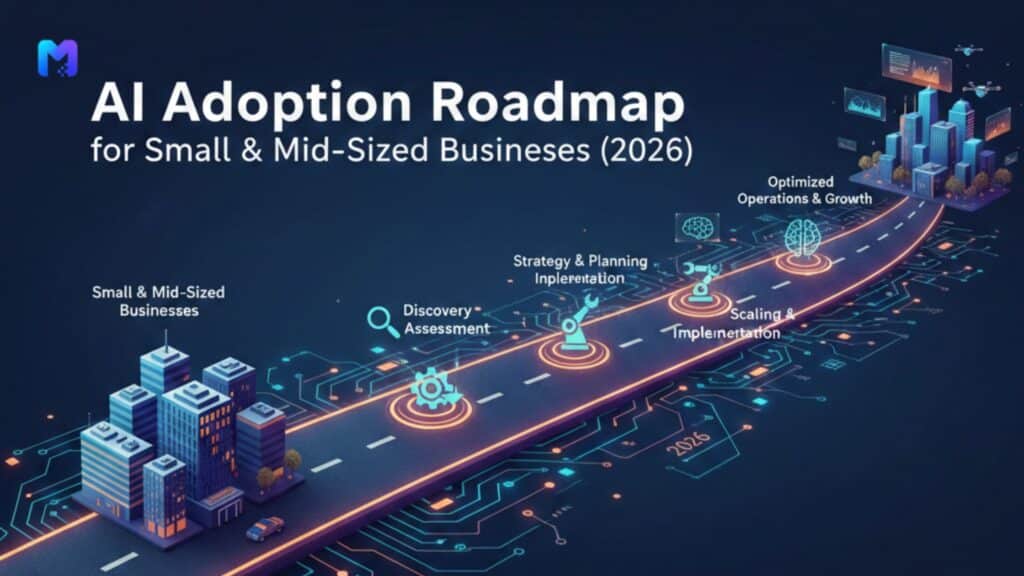
AI Adoption Roadmap for Small & Mid-Sized Businesses

A restaurant owner once told me, “Everyone keeps talking about AI like it’s electricity. But I don’t even know where the switch is.” That sentence perfectly captures where most small and mid-sized businesses stand today. AI feels powerful, inevitable, expensive and confusing. And most importantly, AI feels risky when you don’t fully understand it. By 2026, AI will no longer be something businesses “experiment with.” It will be something businesses either use intelligently or quietly fall behind without realizing why. The real challenge is not whether to adopt AI. The real challenge is how to adopt it without wasting money, breaking trust, or overwhelming teams. At MindAptix Technologies, many conversations start with hesitation: “We are too small for AI.” “Our data isn’t ready.” “It sounds expensive.” “What if it complicates things?” These concerns are valid. This roadmap is built for exactly those realities. Why 2026 changes everything for SMBs Until recently, AI felt like something only large enterprises could afford. That has shifted dramatically. Costs have come down. Tools have matured. Access has widened. Expectations have risen. Customers now expect smarter experiences. Employees expect smarter tools. Competitors are quietly improving operations using automation and intelligence. This doesn’t mean every small business needs advanced AI labs. It means every serious business needs a clear, realistic adoption path. That’s what this roadmap offers. Step 1: Start with business friction, not technology ambition The biggest mistake businesses make with AI is starting with the tool instead of the problem. They ask: “Which AI tool should we use?” “Which model is best?” “Which vendor sounds impressive?” But successful companies start elsewhere. They ask: Where are we losing time every week? Where are teams frustrated? Where do customers drop off? Where do mistakes repeat? Step 2: Build digital foundations before adding intelligence Many businesses want AI before they have solid systems. That leads to disappointment. Before meaningful AI adoption, most SMBs need: Clean data structures Well-organized databases Stable applications Reliable reporting Defined workflows This is where investments like custom web application development become critical. Not because custom solutions are trendy, but because they create clarity. Without clarity in data and processes, AI simply amplifies confusion. A cluttered system with AI added becomes a faster mess. A structured system with AI layered on becomes powerful. This is why strong saas development services and engineering teams often recommend foundational improvements before any AI investment. Step 3: Use AI first for internal efficiency, not customer-facing features A practical roadmap starts internally. Internal AI use cases are: Lower risk Easier to measure Faster to iterate Less visible to customers Highly impactful By 2026, most smart SMBs will use AI internally for: Summarizing meetings Drafting internal documentation Automating routine reporting Analyzing operational data Supporting customer support agents Sorting inbound inquiries This improves productivity without changing the customer experience immediately. Many businesses we’ve worked with saved dozens of hours per month simply by applying AI to internal workflows. That time compounds. That energy shifts. That’s real ROI. And importantly, it builds confidence before moving toward customer-facing AI features. Step 4: Apply AI to revenue-impact areas carefully Once internal efficiency improves, the next step is applying AI where it touches revenue. This is where areas like ecommerce mobile app development become powerful. Examples that consistently work when implemented thoughtfully: Personalized product recommendations Smart product search Predictive offers based on behavior Smarter email segmentation Intelligent pricing adjustments Behavioral analytics on checkout flows These are not gimmicks. These are practical improvements that often increase conversion rates and repeat purchases. However, they must be implemented carefully. Poor personalization feels creepy. Bad predictions feel annoying. Strong implementation feels invisible and helpful. That difference depends on thoughtful design, not just technology. Step 5: Be realistic about mobile app development cost and ROI By 2026, more SMBs will consider AI-enabled mobile experiences. But many underestimate mobile app development cost and overestimate immediate returns. The truth: A well-built app is an investment, not a shortcut AI inside an app should solve real user problems Not every business needs a mobile app Poorly built apps harm trust faster than they help growth This is why mature businesses consult experienced teams like the best app development companies before jumping into development. Good partners ask difficult questions: Why do users need an app? What behavior will change because of it? What business metric will improve? What ongoing investment will maintenance require? These questions protect businesses from expensive mistakes. Step 6: Industry-specific AI adoption requires deeper care Not all industries can treat AI the same way. Healthcare, for example, carries deeper responsibility. Healthcare software development involves: Sensitive data Compliance requirements Ethical responsibilities Trust with patients Accuracy concerns AI in healthcare can help with: Reducing administrative burden Improving scheduling Supporting diagnostics Managing documentation Streamlining patient communication But it must be implemented responsibly. That’s why healthcare companies look for specialized teams rather than general vendors. By 2026, healthcare organizations that handle AI thoughtfully will improve care delivery while maintaining trust. Those who rush will face regulatory and reputational risks. Step 7: Partner selection matters more than tool selection Tools change quickly. Partners shape outcomes. Many SMBs waste money not because AI fails, but because their vendors fail. Strong partners behave differently from average agencies. The best app development companies tend to: Speak honestly about limitations Say no to bad ideas Focus on outcomes instead of features Educate clients instead of confusing them Think long-term instead of chasing quick wins MindAptix Technologies operates in this space: working as a strategic partner rather than a delivery-only vendor. This is what SMBs increasingly need in the AI era. By 2026, businesses will succeed not based on who uses the newest tools, but based on who chooses the wisest partners. Step 8: Measure progress in outcomes, not activity One of the quiet failures in AI adoption is measuring the wrong things. Teams often track: Number of AI features added Number of tools purchased Number of automations created But the only metrics that matter are: Revenue changes Cost savings

AI Adoption Roadmap for Small & Mid-Sized Businesses Read More »

MVP vs POC vs Prototype

MVP vs POC vs Prototype: A Founder’s Complete Guide

If you’re building a product, this question shows up sooner than expected: Should I start with a POC, a prototype, or go straight to MVP? Most founders don’t get stuck because they lack ideas. They get stuck because they choose the wrong starting point and burn time, money, and momentum. I’ve seen smart founders waste months building the wrong thing simply because they didn’t understand the difference between MVP vs POC vs Prototype. So let’s break this down in plain language, without theory, without jargon, and without the usual “consulting-style” fluff. Why this confusion happens so often When you talk to agencies, developers, investors, and product mentors, everyone throws these terms around like they mean the same thing. They don’t. A startup founder hears: “You need a POC first” “You should build a prototype” “You must launch an MVP quickly” And ends up confused because nobody explains when to use what. The truth is simple: Each serves a different purpose, at a different stage, for a different risk. Once you understand that, your product decisions become clearer. What is a POC (Proof of Concept)? A POC answers one question only: Is this technically possible? You build a POC when you’re unsure whether something can even work. It’s not about design. It’s not about users. It’s not about growth. It’s about feasibility. Example situations: Can AI accurately analyze legal documents? Can blockchain handle this transaction load? Can IoT sensors reliably transmit data in rural agriculture? Can your idea for an agriculture mobile app function with low internet bandwidth? A POC is often ugly. Sometimes it’s just backend code. Sometimes it’s a script. Sometimes it’s a rough internal demo. And that’s perfectly fine. Because the goal is not to impress users. The goal is to reduce technical risk. Many founders skip this step and regret it later when they realize their idea doesn’t scale or breaks under real conditions. What is a Prototype? A prototype answers a different question: Will users understand this product? This is where design, user experience, and flow matter. A prototype looks like the product. It feels like the product. But it usually isn’t fully functional. You build a prototype when: You want investor feedback You want early user feedback You want to validate user flow You want to test assumptions before development This is extremely common in: SaaS dashboards Fintech apps Healthcare platforms Real estate web development platforms where UX matters heavily Consumer-facing ecommerce ideas A clickable Figma design, a low-code interactive demo, or a front-end-only build can all count as prototypes. A prototype is not about engineering depth. It’s about clarity of experience. What is an MVP (Minimum Viable Product)? An MVP answers the most important question: Will people actually use this and pay for it? This is where real validation happens. An MVP is not a half-baked product. A good MVP is: Functional Useful Stable Focused on one core problem It just doesn’t have extra features yet. When founders build MVPs properly, they: Launch faster Get real feedback Adjust based on data Save huge development costs This is exactly why most serious startups work with experienced partners like the best mobile app development company in India instead of hiring random freelancers who build without strategy. POC vs Prototype vs MVP: Simple comparison Stage Purpose Focus Audience POC Prove feasibility Tech viability Internal team Prototype Validate usability UX & flow Users / investors MVP Validate business Real usage & revenue Real customers Each step answers a different risk: POC reduces technical risk Prototype reduces usability risk MVP reduces market risk Skipping the right step increases failure chances. Real-world examples founders can relate to Let’s say you’re building: 1. An ecommerce platform You might: Start with a POC to test payment gateway scalability Then build a prototype to validate checkout flow Then launch MVP with core buying/selling features This is exactly how strong ecommerce mobile app development company teams structure projects. 2. A real estate platform With real estate web development, UX matters heavily. So: Prototype becomes crucial to test listing flow Search filters Property comparisons Agent dashboards Skipping prototype here usually leads to poor engagement. 3. An agriculture mobile app For rural users, performance and offline usability matter. So: POC helps test offline syncing Prototype helps test language usability MVP proves whether farmers actually adopt it Each stage plays a real role. Why most founders choose the wrong approach Because they listen to bad advice. Some agencies push MVP when a POC is needed. Some freelancers build prototypes when founders need market validation. Some founders jump into full development because they’re emotionally attached to the idea. This leads to: Wasted budgets Feature-heavy products nobody uses Burnout Pivoting too late I’ve seen this repeatedly. You don’t fail because your idea is bad. You fail because you validate the wrong thing at the wrong time. Where mobile app development strategy really matters If you’re working on: Hybrid mobile app development ios app development services Cross-platform SaaS Consumer apps Enterprise dashboards Your development partner should guide you on whether to build: A POC A prototype Or a lean MVP Not every project should jump straight into development. Strategic product thinking separates average agencies from the best mobile app development company in India. The founder mindset shift that changes everything You stop asking: How fast can I build this? You start asking: What risk am I trying to reduce first? Because building fast is useless if you’re building the wrong thing. Because spending money on development is dangerous if you haven’t validated demand. Because design polish is meaningless if the core value is unclear. This is where experienced product teams add real value. When should you build each? Build a POC when: You’re unsure if the tech will work Your idea relies on complex architecture You’re using emerging tech (AI, ML, blockchain, IoT) Performance, security, or scalability are critical Build a Prototype when: You need user validation You’re pitching investors You’re testing flows and experience You’re unsure how people

MVP vs POC vs Prototype: A Founder’s Complete Guide Read More »

Why Most App Development Projects Fail (And How to Avoid It)

Why Most App Development Projects Fail (And How to Avoid It)

Every business owner I know who’s built an app has a story. Sometimes it’s a success story. More often, it starts with excitement and ends with frustration. The idea felt solid. The budget seemed reasonable. The timeline looked achievable. But months later, the product didn’t match expectations. Deadlines slipped. Features broke. Users didn’t engage. And the investment didn’t bring the returns everyone hoped for. This happens more often than people admit. And it doesn’t mean app development itself is broken. It means the way many projects are approached is flawed from the beginning. Let’s talk honestly about why most app development projects fail — and how businesses can avoid repeating the same mistakes. Most failures begin before a single line of code is written One of the biggest mistakes businesses make is jumping straight into development because the idea feels exciting. I’ve seen founders skip validation entirely, assuming users will automatically want what they’re building. Instead of seeking real feedback, they rely on internal opinions and move forward on gut instinct rather than clear market signals. The idea wasn’t properly validated, so the app ends up solving the wrong problem.Without real conversations with users, the features feel disconnected from reality.When early assumptions go unchallenged, the product slowly drifts off course. A good app development company doesn’t just say yes to everything. The right application development company in USA will push back, ask questions, and slow things down in the beginning. That may feel uncomfortable at first, but it protects your money and your long-term goals. Validation workshops, competitor analysis, user interviews, and MVP planning are not “extra work.” They are what separates successful products from expensive experiments. The wrong development partner can quietly sink everything On the surface, many vendors look similar. Everyone claims to be among the top app development companies. Every website shows polished portfolios and confident messaging. But once the project begins, the differences become painfully clear. Some teams struggle with weak processes.Others lack technical depth.A few fall short on ownership.Some simply overpromise to win deals. Businesses searching for mobile app development USsoft partners often choose based on cost rather than competence. Unfortunately, cheaper vendors often lead to higher long-term costs because the work has to be redone, performance issues pile up, and technical debt grows. A strong app development company behaves differently. They document everything. They communicate clearly. They set realistic expectations. They think beyond launch day. They care about your business outcomes, not just delivery milestones. That’s why long-term website app development services matter more than short-term project execution. You’re not hiring someone to “build an app.” You’re choosing a team to support a product that should evolve with your business. Communication breakdowns cause slow, invisible damage This problem rarely shows up in proposals, but it destroys projects quietly. Business teams speak in goals, revenue, growth, and customers. Developers speak in architecture, sprints, deployments, and integrations. If nobody connects these two worlds properly, everything becomes messy. Features get misunderstood.Priorities change without clarity.Timelines stop making sense.Trust erodes slowly. Good communication isn’t about more meetings. It’s about structure. The best application development company in USA will assign product managers who can translate business goals into technical direction. That role becomes the anchor for the entire project. Without it, you don’t get alignment. And without alignment, even talented teams struggle. Also read 1. Hidden Costs of Mobile App Development No One Really Talks About 2. How AI Is Changing Mobile App Development in 2026 Unrealistic timelines create pressure that ruins quality Every client wants speed. That’s normal. But there’s a big difference between efficiency and fantasy. Building a serious product takes time because it involves design thinking, architecture planning, testing, security, performance optimization, and iteration. When vendors promise “full apps in four weeks,” it usually means corners will be cut somewhere. When corners get cut early, problems appear later. Technical debt accumulates. Bugs increase. Performance suffers. Scaling becomes painful. Maintenance costs rise. A mature app development company will explain tradeoffs honestly. They will help you break work into phases. They will propose realistic timelines. They will guide you toward smarter investments rather than rushed delivery. That honesty often separates professional teams from those simply trying to win deals. Many apps fail because nobody plans for growth A surprising number of projects are built as if they will never grow. The architecture supports today’s needs but collapses under tomorrow’s demand. Because scalability wasn’t considered, performance degrades when users increase.Because structure wasn’t planned, new features become harder to add.Because infrastructure was rushed, stability suffers under pressure. This is where software development embedded principles become critical. Building modular systems, scalable components, and flexible architecture allows products to grow without constant rewrites. The top app development companies think about where your product will be two years from now, not just where it is today. User experience is often treated as decoration instead of strategy Many businesses underestimate how quickly users judge apps. People don’t give products multiple chances. They open an app, feel confused for ten seconds, and uninstall. If navigation feels clunky, users leave.If onboarding feels complicated, users leave.If performance feels slow, users leave. Strong website app development services prioritize usability at every stage. They test designs with real users. They study behavior. They refine flows. They simplify journeys. This work doesn’t feel glamorous, but it drives adoption and retention more than flashy features ever will. A professional app development company invests in understanding how real humans interact with software, not just how systems function. Launch is not the finish line, but many teams treat it like one This is one of the most damaging misconceptions in app development. Some projects treat delivery as the end. Once the app goes live, momentum fades. Bugs linger. Feedback gets ignored. Improvements stall. The product slowly loses relevance. When teams commit to ongoing ownership, products evolve.When teams monitor analytics regularly, decisions improve.When teams iterate consistently, users stay engaged. (That’s the second intentional sequence of three consecutive sentences starting with the same word.) Long-term

Why Most App Development Projects Fail (And How to Avoid It) Read More »

How AI Is Changing Mobile App Development in 2026

How AI Is Changing Mobile App Development in 2026

Mobile apps used to be simple tools. You downloaded them, used a few features, and that was it. Today, they behave more like digital assistants that quietly adjust to your habits. And in 2026, that shift has become impossible to ignore. Open any well-designed app and the difference is obvious. Your preferences are remembered, suggestions feel timely, and interactions seem intuitive. Instead of feeling like basic software, the experience feels more personal – almost like the product truly understands you. This shift didn’t happen by chance. It’s driven by artificial intelligence becoming part of the foundation of modern product development, rather than being treated as an add-on feature at the final stage. This change matters whether you’re a founder, a product manager, a business owner, or someone planning their next digital product. Apps are starting to behave differently Earlier apps were mostly static. Every user saw the same screens. Every user followed the same flows. Updates happened slowly, and personalization was limited to basic settings. That’s no longer how things work. In 2026, apps respond to behavior in real time. They adjust layouts, reorder content, reduce friction, and quietly improve the experience based on how people actually use them. You don’t need to configure much. It happens in the background. This has changed the way teams approach business mobile app development. The goal is no longer “launch and forget.” The goal is to build something that keeps learning long after launch. Personalization that feels useful, not annoying People like personalization when it saves time. They hate it when it feels invasive. Good AI-powered apps in 2026 walk that line carefully. They don’t overload users with unnecessary suggestions. Instead, they focus on small improvements that make everyday use smoother. You’ll see it in simple moments: That kind of experience is becoming standard across mobile app development US markets. If an app feels generic today, users simply uninstall it and move on. Developers aren’t being replaced, they’re working smarter There’s a lot of noise online about AI replacing developers. In real product teams, that’s not what’s happening. Instead, developers are using AI as support. It helps with repetitive tasks, flags bugs earlier, suggests cleaner solutions, and speeds up testing. The thinking still belongs to humans. The decisions still belong to humans. The architecture still belongs to humans. Many teams offering ai software development services rely on these tools daily, not to cut corners, but to free up time for deeper work. Stronger structure, higher performance, and long-term scalability. Clients working with an experienced application development company in USA usually notice the impact through smoother collaboration and fewer technical surprises. Testing feels closer to real user behavior Testing used to be mechanical. Click this button. Fill this field. Check that response. Useful, but limited. Now, AI-driven testing tools behave more like unpredictable humans. They scroll too fast. They abandon flows mid-way. They switch networks. They use apps in odd sequences. They expose the weak points. This is especially valuable for products that expect large traffic or complex user journeys. Teams working seriously in mobile app development US ecosystems depend on this kind of testing to avoid embarrassing failures after launch. It’s not about perfection. It’s about resilience. Web and mobile are no longer separate worlds Users don’t care whether they’re using a mobile app or a browser. They just expect everything to work smoothly. Users often begin a task on their laptop during work hours and pick it up later on their phone. They now expect their preferences, progress, and behavior to remain consistent across devices. That’s why modern web app development is now tightly connected to mobile strategy. Teams offering strong web application development services are building platforms where AI logic works across devices, not just within a single interface. The experience should feel continuous, not fragmented. Voice, camera, and natural interaction are becoming normal Typing isn’t the default input method anymore. Users now speak to apps, scan documents, and upload photos to trigger actions. Instead of rigid commands, they expect systems to understand natural language and respond intelligently. This is quietly changing product design. Forms are getting shorter. Navigation is getting simpler. Interaction feels less technical. Good web app development and mobile experiences now consider these behaviors from the very beginning, not as optional extras. Trust, privacy, and ethics matter more than ever Users are more informed today. They review permissions, recognize when apps overreach, and care deeply about how their data is used. Forward-thinking teams take this responsibility seriously. They design AI systems that respect privacy, avoid dark patterns, and prioritize transparency at every stage. This isn’t just a legal concern anymore. It’s a product quality issue. Trust is part of user experience now. Companies like Mindaptix emphasize this balance – building intelligent systems while still respecting user control and business responsibility. What businesses should actually focus on A lot of businesses get distracted by trends. They ask for “AI features” without understanding why. The better questions sound more practical: Teams offering serious ai software development services spend more time on these questions than on flashy demos. That’s where real value comes from. The future feels less technical, more human Ironically, as technology becomes more advanced, the best products feel less technical. You rarely think about how the app works – you simply notice that it does. The experience feels effortless, with no confusion, friction, or wasted time. That’s what AI is quietly enabling when implemented properly. The winners in this space won’t be the companies chasing hype. They’ll be the ones investing in thoughtful business mobile app development, strong web application development services, and long-term product thinking. Final thought AI is changing mobile app development in 2026, but not in the dramatic sci-fi way people like to imagine. The real change is subtler and more meaningful. Apps are becoming calmer. Smarter. More responsive. More respectful of time. When that happens, users don’t praise the technology. They just stay. They use the product. They trust it. And honestly, that’s

How AI Is Changing Mobile App Development in 2026 Read More »

AI vs Automation vs RPA: What Should Businesses Choose?

AI vs Automation vs RPA: What Should Businesses Choose?

Every business today hears the same advice: “Use AI”, “Automate everything”, “Adopt RPA”.It sounds exciting, but it also creates confusion. Leaders often nod in meetings without fully understanding what each term actually means. Teams invest in tools that look impressive on paper but deliver very little impact. If you are running a business, managing operations, or planning digital growth, you don’t need buzzwords. You need clarity. This article breaks down AI, Automation, and RPA in plain language so you can make practical decisions without getting lost in technical jargon. The Real Problem Businesses Are Trying to Solve Most companies don’t wake up wanting “AI”. They wake up wanting: AI, Automation, and RPA are simply different ways to achieve those goals. The right choice depends on how your business actually works day to day. What Automation Actually Means in Real Life Automation is the simplest layer. It’s about setting rules so routine tasks happen without human involvement. Think about: No intelligence. No learning. Just “If this happens, do that.” Automation is extremely useful because most businesses run on repetitive processes. Removing even small manual steps can save hours every week. Best use cases for automation Automation is affordable, low risk, and often the first step toward smarter operations. What RPA Looks Like Inside a Company RPA (Robotic Process Automation) is a step further. Instead of integrating systems directly, RPA bots behave like virtual employees. They can: This is extremely helpful when companies rely on older systems that don’t connect easily. Example that feels real A finance executive once shared that two employees spent almost their entire week downloading reports from one system and uploading them into another. After RPA implementation, the bot completed the same work every morning before anyone logged in. The result wasn’t just time savings. It reduced errors and improved team morale. The limits of RPA RPA still follows rules. If something changes on the screen, or an unexpected scenario occurs, the bot can fail. It’s efficient, but not intelligent. Where AI Fits Into the Picture AI is different because it brings learning into the system. It does not just follow instructions. It improves with data. AI systems can: Businesses using professional ai software development services typically go beyond efficiency. They focus on smarter products, better user experience, and stronger competitive advantage. Real-world AI examples AI is powerful, but it requires strategy. Without the right data and goals, it can become an expensive experiment. Simple Breakdown: Automation vs RPA vs AI Factor Automation RPA AI Learns from data No No Yes Handles complex decisions No Limited Yes Best for Basic workflows Manual system tasks Intelligence-driven use cases Setup complexity Low Medium High Long-term advantage Moderate Moderate Strong None of these options is “better” by default. The best choice depends on your business reality. How Smart Businesses Actually Use These Technologies Most successful companies don’t choose only one. They build layers. Businesses often begin with automation to streamline simple processes.As manual work across systems starts slowing teams down, RPA becomes the next logical step.When the goal shifts toward smarter products and stronger decision-making, investing in AI makes sense. This approach feels natural because it grows alongside the business. The Role of Digital Products in This Decision Technology only works when it fits naturally into your product and user journey. That’s why architecture matters. A strong web application development company designs platforms that support automation, connect smoothly with RPA flows, and allow AI features to grow over time. The same applies to business mobile app development, where users now expect personalization, speed, and intelligent experiences as standard. It’s not about adding features for show. It’s about building systems that make life easier for both teams and customers. Common Mistakes That Waste Time and Budget Jumping straight to AI without fixing basics Some companies try advanced AI while still struggling with broken internal processes. That rarely ends well. Buying tools without a strategy Shiny software looks attractive. Without clear use cases, it becomes shelfware. Treating implementation as a one-time task Automation flows need refinement. RPA bots need monitoring. AI models need retraining. This is ongoing work. A Practical Scenario Picture a mid-sized service company. At first, they automate client onboarding emails and scheduling.Later, they introduce RPA to handle reporting between CRM and billing tools.Eventually, they use AI to predict churn and improve client retention. Each step supports real outcomes: saving time, reducing stress, improving growth. That’s how technology should feel: helpful, not overwhelming. Making the Right Choice When speed and consistency matter most, automation delivers quick results.For businesses struggling with heavy manual work between disconnected systems, RPA is a practical solution.If the goal includes smarter decision-making and stronger personalization, AI becomes a valuable long-term investment. There’s no universal answer. There is only the answer that fits your business today. Companies like Mindaptix often support businesses by aligning technology decisions with product goals, user expectations, and long-term growth, instead of pushing trends that don’t match reality. Final Thoughts AI, Automation, and RPA are not competing options. They are different tools solving different problems. The smartest approach is honest evaluation: When technology is chosen based on real needs instead of hype, it stops feeling like a cost and starts feeling like a competitive advantage. Key Takeaways FAQs

AI vs Automation vs RPA: What Should Businesses Choose? Read More »

Hidden Costs of Mobile App Development No One Really Talks About

Hidden Costs of Mobile App Development No One Really Talks About

In an era where users expect exceptional experiences on both mobile and web, businesses can no longer afford to operate with siloed development efforts. The evolution of cross-platform app development has transformed how we think about building digital products. One solution codebase, multiple platforms—this is the promise. But achieving it well requires the right mobile application development frameworks and tools, a clear strategy, and an awareness of the trends driving cross‐platform mobile app development. This article will walk you through: 1. What is Cross-Platform App Development & Why It Matters When we talk about cross-platform app development, we refer to building applications that run on more than one device platform (e.g., iOS, Android, web) using a shared or unified code base. This stands in contrast to purely native development (where you build separate codebases for each platform) or purely web app development (which runs inside a browser). 1.1 The case for cross‐platform Lower cost and faster time-to-market. As one industry guide puts it: with cross‐platform you can “write once, run everywhere”.  Consistent user experience across devices. By sharing large parts of the business logic and UI, you ensure feature parity and design consistency. Easier maintenance. Fix a bug or add a feature once, deploy across multiple platforms, rather than repeating efforts.   Scalability into new platforms. Many modern frameworks now support more than mobile (such as desktop or embedded) “for free”. In 2025 this matter more than ever.  1.2 Where cross‐platform fits in your mobile/web strategy It’s helpful to view cross-platform development as one axis in your application development strategy: If you need maximum performance, deep native capabilities (e.g., GPU-intensive, AR/VR, custom platform APIs) → native may still be the right choice.   If you want faster delivery, consistent experience across platforms, cost efficiency, and reach → cross-platform is compelling. 1.3 Why 2025 is a milestone We are entering a phase where cross-platform is no longer “just cost-saving” but a strategic business capability. For example: Frameworks such as Flutter and React Native are evolving to support desktop and embedded in addition to mobile.  AI, edge-computing, and IoT integration are becoming more common, meaning your cross-platform stack must be ready for more than phones. “Web + mobile + desktop” convergence requires unified toolchains, which makes the right framework choice even more critical.  2. What to Look for in Cross-Platform App Development Frameworks Selecting the right framework is one of the most important decisions in application development. Here are key criteria to evaluate: 2.1 Performance & user experience Even though you share code, users expect native-like responsiveness, smooth animations, and platform-specific UI paradigms (e.g., iOS vs Android). Choose a framework that delivers near-native performance.  2.2 Code reusability and architecture How much of your code (business logic + UI) can you share? A strong cross-platform framework maximises reuse without compromising platform-specific needs.  2.3 Ecosystem and tooling Consider developer tooling (hot reload, debugging, build pipelines), plugin ecosystem for native features (camera, sensors, payment), and community support. For example, Flutter supports rich widgets and hot-reload.  2.4 Platform coverage & future-proofing Does the framework support not just mobile but web, desktop, embedded? Will it scale in the future? For 2025, this is increasingly important.  2.5 Maintainability & vendor neutrality Avoid lock-in; favour open-source or strong community frameworks. Consider how easy it is to maintain, upgrade, and onboard new developers. 2.6 Integration with backend , cloud & modern toolchains Your Mobile or Web app development  is just one part of the stack. Ensure the framework plays nicely with your backend services, APIs, CI/CD workflows, analytics, and DevOps pipelines. 2.7 Learning curve and team skills Consider your team’s existing skills. If you have web developers comfortable with React, a React-based framework may speed things up. If your team is mobile native heavy (Kotlin/Swift), then perhaps a multiplatform approach is better. 3. Top Platforms & Frameworks for Cross-Platform Mobile/Web Apps in 2025 Below we survey the most relevant frameworks and platforms in the cross-platform space.  3.1 Flutter (by Google) Overview: Flutter is a UI toolkit by Google that uses the Dart language and builds high-performance apps across iOS, Android, web, desktop and embedded. Strengths: Considerations: 3.2 React Native (by Meta) Overview: React Native is built on JavaScript/TypeScript and React, enabling reuse of web-development skills for mobile apps. Strengths: Considerations: 3.3 Kotlin Multiplatform (KMP) Overview: Kotlin Multiplatform enables sharing of business logic across iOS, Android and other platforms (UI can be platform-specific or shared via Kotlin/Compose). Especially interesting for teams with native Android + Kotlin expertise.  Strengths: Considerations: 3.4 Xamarin / .NET MAUI Overview: Microsoft’s offering for cross-platform development leveraging C#, .NET ecosystem. With .NET MAUI (Multi-platform App UI), developers can target iOS, Android, Windows and Mac from a single codebase. Strengths: Considerations: 3.5 Ionic / Capacitor / Hybrid Web-based Frameworks Overview: Ionic (often combined with Capacitor or Cordova) allows building apps using web technologies (HTML/CSS/JavaScript) and then deploying to mobile platforms. Strengths: Considerations: Ideal for: Content-driven apps, PWA-first strategies, teams focused on web and mobile simultaneously and willing to accept some trade-offs. 4. Practical Guidance: Toolchain, Workflow & Architecture Understanding frameworks is only half the game — implementing them effectively in application development requires good practices, architecture, and integration. Here are actionable considerations. 4.1 Selecting your stack Define your goals: Are you building consumer apps or enterprise tools? Is UI richness a priority? What platforms do you need (mobile only, mobile+web, mobile+desktop)? Evaluate future plans: Will you need desktop, embedded or wearables later? Choose a stack that leaves room for expansion. Prototype and test: Build a small proof-of-concept to validate performance, plugin availability, and team productivity before committing. 4.2 Architecture and code sharing strategy 4.3 Development workflow, CI/CD & QA 4.4 Maintenance, updates and versioning 4.5 Performance optimisation & native look & feel Although cross-platform frameworks have come a long way, you still must optimise: lazy-load resources, reduce initial bundle size, avoid heavy animations if not needed, use native modules for performance-critical parts.  Follow platform-specific UI guidelines: Even if you share most UI, adapting to iOS/Android nuances (navigation patterns, UI behaviours) improves

Hidden Costs of Mobile App Development No One Really Talks About Read More »

Saas

Custom Software vs SaaS: Which One Is Right for Your Business?

Every business reaches a point where spreadsheets, emails, and manual work are no longer enough. That’s usually when the conversation around software starts. Some companies jump straight into buying a SaaS tool. Others think about building something of their own. And many feel confused because everyone seems to recommend something different. The truth is simple: there is no universal right answer. What works perfectly for one business can become a headache for another. The real challenge is understanding what you actually need today and what you’ll need a few years down the line. This article looks at custom software and SaaS from a practical, business-first point of view. No hype. No technical overload. Just honest comparison to help you make a smarter decision. What SaaS Really Means in Day-to-Day Business SaaS, or Software as a Service, is software you rent instead of owning. You log in, pay a monthly or yearly fee, and use it along with thousands of other companies. For many businesses, SaaS feels like a relief. No setup stress. No development wait. No technical maintenance. Everything is already built. And that’s exactly why SaaS works so well in the early stages. Why SaaS Feels Like the Easy Choice SaaS tools solve common problems. Accounting, HR, CRM, email marketing, project tracking-most businesses need these in one form or another. Here’s why companies often choose SaaS first: This convenience is why many startups and small businesses work with a saas development company or adopt ready-made SaaS platforms before thinking about anything custom. The Side of SaaS People Realize Later Problems with SaaS usually don’t appear on day one. They show up slowly. As your business grows, you start noticing things like: At some point, the software starts controlling your process instead of supporting it. This is where many businesses pause and rethink their approach. Custom Software: Built Around How You Actually Work Custom software is designed specifically for one business. It’s not meant to serve thousands of users with different needs. It’s built to solve your problems, in your way. This doesn’t mean it’s always complex or expensive. It means it’s intentional. Why Businesses Choose Custom Software Custom software makes sense when software is no longer just a tool, but a core part of operations. Companies often move toward custom solutions when: When developed properly, custom software removes friction instead of adding it. This is why businesses that work closely with teams offering software development and services often see better efficiency over time, even if the initial investment is higher. Ownership Makes a Big Difference One overlooked benefit of custom software is ownership. With SaaS, you’re renting access. The provider can change pricing, remove features, or even shut down the product. With custom software, the system belongs to you. You decide how it grows, what changes, and when updates happen. That control becomes extremely valuable as a business matures. Cost: The Part Most Businesses Misjudge Let’s talk about money, because this is where many decisions go wrong. SaaS Costs Over Time SaaS looks affordable at first. But the cost is ongoing. You pay: As your team grows, so does the bill. Over several years, SaaS costs can quietly become a major expense. Custom Software Costs Upfront Custom software requires an initial investment. There’s no way around that. Design, development, testing, and deployment all take time and money. But once it’s built: Many companies that consult best app development companies find that custom software becomes more cost-effective after a few years. Flexibility: The Real Difference Between SaaS and Custom This is where the gap becomes obvious. SaaS Flexibility Is Limited by Design SaaS tools are built for the average user. Customization options exist, but only within fixed boundaries. If your business logic doesn’t fit those boundaries, you’re stuck. Workarounds become normal. Manual steps creep in. Teams waste time adjusting to the tool. Custom Software Adjusts as You Grow Custom software evolves with your business. New features can be added when needed. Processes can change without breaking everything. Integrations are built specifically for your systems. Companies investing in saas application development services often do so because they want SaaS-level scalability with custom-level control. Security and Data Control For some businesses, security is non-negotiable. SaaS providers do offer security, but your data lives on shared infrastructure. That’s fine for many companies, but not all. Custom software allows: Businesses in finance, healthcare, or enterprise environments often choose custom solutions for this reason alone. Speed vs Accuracy SaaS is fast. Custom software is accurate. If you need something running tomorrow, SaaS is the obvious choice. If you need something that works exactly the way your business does, custom software is worth the wait. Many companies start with SaaS, learn what works and what doesn’t, and later build custom solutions based on real experience. There’s nothing wrong with that path. So, Which One Should You Choose? Ask yourself honestly: If the answers lean toward “yes,” custom software is likely the better long-term option. If your needs are standard, your team is small, and speed matters most right now, SaaS will probably serve you well. Final Thoughts Choosing between custom software and SaaS isn’t about trends or buzzwords. It’s about alignment. SaaS offers convenience and speed. Custom software offers control and precision. Strong businesses don’t blindly choose one. They evaluate where they are, where they’re going, and what kind of systems will support that journey. Key Takeaways FAQs

Custom Software vs SaaS: Which One Is Right for Your Business? Read More »