A restaurant owner once told me,
“Everyone keeps talking about AI like it’s electricity. But I don’t even know where the switch is.”
That sentence perfectly captures where most small and mid-sized businesses stand today.
AI feels powerful, inevitable, expensive and confusing.
And most importantly, AI feels risky when you don’t fully understand it.
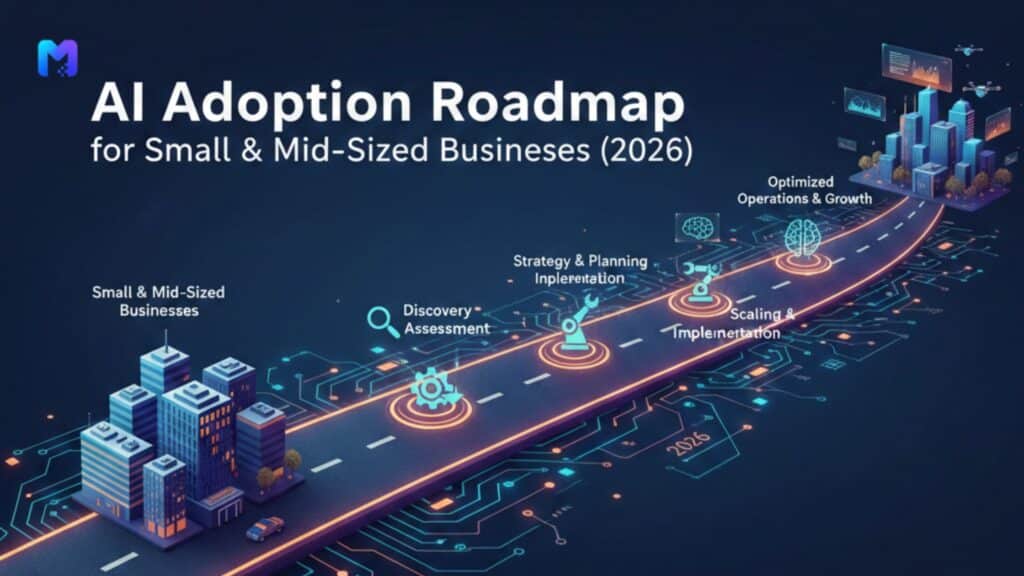
By 2026, AI will no longer be something businesses “experiment with.” It will be something businesses either use intelligently or quietly fall behind without realizing why. The real challenge is not whether to adopt AI. The real challenge is how to adopt it without wasting money, breaking trust, or overwhelming teams.
At MindAptix Technologies, many conversations start with hesitation:
- “We are too small for AI.”
- “Our data isn’t ready.”
- “It sounds expensive.”
- “What if it complicates things?”
These concerns are valid. This roadmap is built for exactly those realities.
Why 2026 changes everything for SMBs
Until recently, AI felt like something only large enterprises could afford. That has shifted dramatically.
Costs have come down.
Tools have matured.
Access has widened.
Expectations have risen.
Customers now expect smarter experiences. Employees expect smarter tools. Competitors are quietly improving operations using automation and intelligence.
This doesn’t mean every small business needs advanced AI labs. It means every serious business needs a clear, realistic adoption path.
That’s what this roadmap offers.
Step 1: Start with business friction, not technology ambition
The biggest mistake businesses make with AI is starting with the tool instead of the problem.
They ask:
- “Which AI tool should we use?”
- “Which model is best?”
- “Which vendor sounds impressive?”
But successful companies start elsewhere. They ask:
- Where are we losing time every week?
- Where are teams frustrated?
- Where do customers drop off?
- Where do mistakes repeat?
Step 2: Build digital foundations before adding intelligence
Many businesses want AI before they have solid systems. That leads to disappointment.
Before meaningful AI adoption, most SMBs need:
- Clean data structures
- Well-organized databases
- Stable applications
- Reliable reporting
- Defined workflows
This is where investments like custom web application development become critical. Not because custom solutions are trendy, but because they create clarity. Without clarity in data and processes, AI simply amplifies confusion.
A cluttered system with AI added becomes a faster mess.
A structured system with AI layered on becomes powerful.
This is why strong saas development services and engineering teams often recommend foundational improvements before any AI investment.
Step 3: Use AI first for internal efficiency, not customer-facing features
A practical roadmap starts internally.
Internal AI use cases are:
- Lower risk
- Easier to measure
- Faster to iterate
- Less visible to customers
- Highly impactful
By 2026, most smart SMBs will use AI internally for:
- Summarizing meetings
- Drafting internal documentation
- Automating routine reporting
- Analyzing operational data
- Supporting customer support agents
- Sorting inbound inquiries
This improves productivity without changing the customer experience immediately.
Many businesses we’ve worked with saved dozens of hours per month simply by applying AI to internal workflows. That time compounds. That energy shifts. That’s real ROI.
And importantly, it builds confidence before moving toward customer-facing AI features.
Step 4: Apply AI to revenue-impact areas carefully
Once internal efficiency improves, the next step is applying AI where it touches revenue.
This is where areas like ecommerce mobile app development become powerful.
Examples that consistently work when implemented thoughtfully:
- Personalized product recommendations
- Smart product search
- Predictive offers based on behavior
- Smarter email segmentation
- Intelligent pricing adjustments
- Behavioral analytics on checkout flows
These are not gimmicks. These are practical improvements that often increase conversion rates and repeat purchases.
However, they must be implemented carefully. Poor personalization feels creepy. Bad predictions feel annoying. Strong implementation feels invisible and helpful.
That difference depends on thoughtful design, not just technology.
Step 5: Be realistic about mobile app development cost and ROI
By 2026, more SMBs will consider AI-enabled mobile experiences. But many underestimate mobile app development cost and overestimate immediate returns.
The truth:
- A well-built app is an investment, not a shortcut
- AI inside an app should solve real user problems
- Not every business needs a mobile app
- Poorly built apps harm trust faster than they help growth
This is why mature businesses consult experienced teams like the best app development companies before jumping into development.
Good partners ask difficult questions:
- Why do users need an app?
- What behavior will change because of it?
- What business metric will improve?
- What ongoing investment will maintenance require?
These questions protect businesses from expensive mistakes.
Step 6: Industry-specific AI adoption requires deeper care
Not all industries can treat AI the same way.
Healthcare, for example, carries deeper responsibility.
Healthcare software development involves:
- Sensitive data
- Compliance requirements
- Ethical responsibilities
- Trust with patients
- Accuracy concerns
AI in healthcare can help with:
- Reducing administrative burden
- Improving scheduling
- Supporting diagnostics
- Managing documentation
- Streamlining patient communication
But it must be implemented responsibly. That’s why healthcare companies look for specialized teams rather than general vendors.
By 2026, healthcare organizations that handle AI thoughtfully will improve care delivery while maintaining trust. Those who rush will face regulatory and reputational risks.
Step 7: Partner selection matters more than tool selection
Tools change quickly. Partners shape outcomes.
Many SMBs waste money not because AI fails, but because their vendors fail.
Strong partners behave differently from average agencies. The best app development companies tend to:
- Speak honestly about limitations
- Say no to bad ideas
- Focus on outcomes instead of features
- Educate clients instead of confusing them
- Think long-term instead of chasing quick wins
MindAptix Technologies operates in this space: working as a strategic partner rather than a delivery-only vendor. This is what SMBs increasingly need in the AI era.
By 2026, businesses will succeed not based on who uses the newest tools, but based on who chooses the wisest partners.
Step 8: Measure progress in outcomes, not activity
One of the quiet failures in AI adoption is measuring the wrong things.
Teams often track:
- Number of AI features added
- Number of tools purchased
- Number of automations created
But the only metrics that matter are:
- Revenue changes
- Cost savings
- Time saved
- Error reduction
- Customer satisfaction
- Employee satisfaction
A thoughtful roadmap always includes clear success criteria. Without that, AI adoption becomes performative instead of productive.
Strong saas development services teams build measurement into the system, not as an afterthought.
The emotional journey of AI adoption for SMB leaders
Let’s be honest. AI adoption is not just technical. It’s emotional.
Leaders worry:
- Will this confuse my team?
- Will customers feel uncomfortable?
- Will we waste money?
- Will I make the wrong call?
- Will I look uninformed?
These feelings are normal. They are rarely discussed publicly, but they shape decisions every day.
Good partners understand this. They explain clearly, avoid jargon ,slow down when needed. They build confidence, not pressure.
This human element is part of responsible technology leadership.
What successful AI adoption looks like by 2026
Businesses that succeed with AI over the next year or two will likely share common traits:
- They start small instead of attempting massive transformations
- They invest in clean data and strong foundations
- They focus on real problems instead of trends
- They choose partners carefully
- They treat AI as a long-term capability, not a quick feature
- They respect customer trust above short-term gains
They won’t necessarily have the flashiest technology.
They will have the calmest operations.
The clearest dashboards.
The strongest customer relationships.
And quietly, their competitors will wonder how they seem to move faster with less chaos.
Final thoughts: AI is not the goal. Stronger business is.
AI adoption should never be about looking modern.
It should be about:
- Reducing friction
- Supporting teams
- Improving customer experience
- Strengthening decisions
- Protecting long-term sustainability
When treated with maturity, AI becomes less intimidating and more practical. Less magical and more useful. Less about buzz and more about progress.
That’s the roadmap most small and mid-sized businesses need in 2026. Not grand promises. Not shiny demos. But thoughtful steps forward.
And with the right strategy, the right structure, and the right partners, AI becomes not a burden – but a quiet advantage working in the background every day.
5 Key Takeaways
- Start AI adoption by addressing real business pain points, not by chasing trends.
- Clean data, stable systems, and clear workflows are essential before AI implementation.
- Internal AI applications often deliver ROI faster than customer-facing features.
- Partnering with experienced teams like the best app development companies ensures successful adoption.
- Measure AI success through outcomes like cost savings, revenue growth, and improved customer experience.
FAQs
- Can small businesses afford AI adoption in 2026?
Yes. Scalable AI solutions now fit budgets of small and mid-sized businesses with measurable ROI. - Should AI be applied internally or for customers first?
Start internally to improve productivity, reduce errors, and build confidence before customer-facing applications. - How does AI affect mobile app development cost?
AI can increase upfront costs, but proper integration in ecommerce mobile app development or other apps often boosts revenue and efficiency. - Do I need custom web application development for AI?
Custom web applications often provide the clean structure AI needs to operate effectively and reliably. - How do SaaS development services help with AI adoption?
Experienced SaaS development services integrate AI thoughtfully, ensuring alignment with business goals and scalability.