A few years ago, a startup founder sat across from me during a strategy call and said something honest:
“Everyone keeps giving me solutions. Nobody is helping me make decisions.”
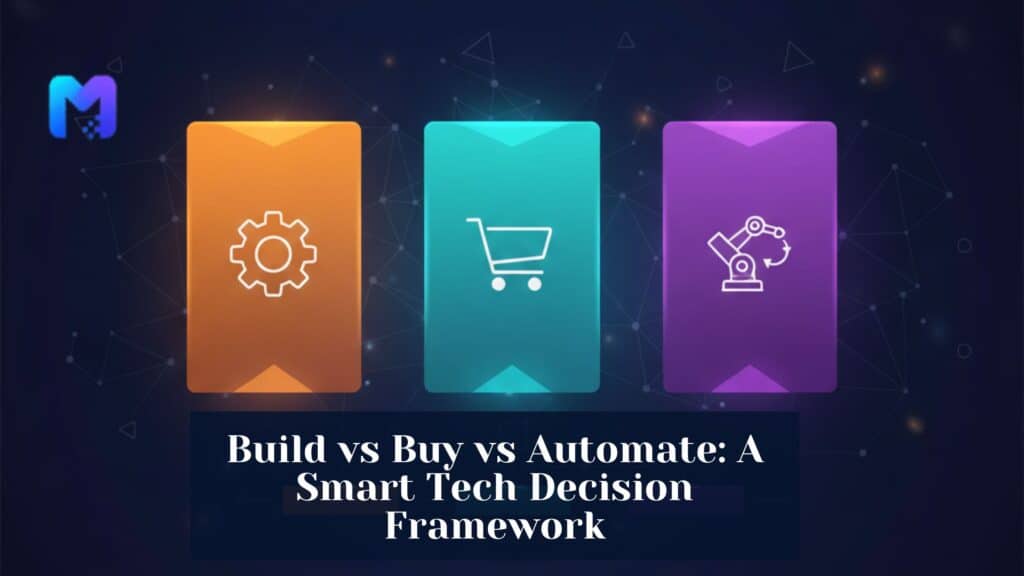
He had three vendors pitching three different directions:
- One said, “Build everything from scratch.”
- Another said, “Just buy SaaS tools.”
- A third said, “Automate it all with AI.”
All sounded convincing. All showed impressive demos. But none answered the real question:
What makes sense for this business, right now, with this team, budget, and growth stage?
This dilemma plays out every day across startups, enterprises, healthcare platforms, ecommerce brands, and internal IT teams. The real challenge is not technology availability. The real challenge is decision clarity.
This is where a strong framework matters more than trendy advice.
Why this decision feels so heavy (and personal)
Technology choices don’t feel neutral because they’re not.
When leaders choose to build, buy, or automate, they are also deciding:
- How much control they want
- How much risk they can tolerate
- How dependent they are willing to be on vendors
- How scalable their operations need to become
- How future-proof their systems should feel
This is not just technical. It’s emotional.
Founders worry about burning capital.
CTOs worry about long-term maintainability.Product heads worry about user experience.
Operations teams worry about complexity.
Good software development services don’t just provide code. They provide calm, clarity, and honest guidance when the decision feels overwhelming.
Understanding the real meaning of Build, Buy, and Automate
Let’s simplify this without oversimplifying.
Build means creating a custom solution tailored exactly to your business workflows.
Buy means adopting existing tools or platforms that already solve part of your problem.
Automate means using technology to reduce manual effort across processes.
Each path has strengths. Each has hidden trade-offs. The mistake happens when companies choose based on trends instead of context.
That’s why app programming companies with real experience focus on frameworks, not fixed answers.
When building custom software actually makes sense
Custom development gets criticized sometimes for being expensive. That criticism is often justified – when it’s done for the wrong reasons.
But in many real-world scenarios, building is the smartest long-term decision.
Building is usually the right direction when:
- Your workflows are deeply unique
- Your competitive advantage depends on proprietary logic
- Existing tools force constant compromises
- You need full control over data and compliance
- Scalability is central to your business model
This is common in:
- Healthcare platforms
- Fintech products
- Logistics systems
- Marketplace businesses
- Deep tech startups
For example, companies looking for the best healthcare app development company rarely succeed with generic SaaS tools. Healthcare requires strict compliance, data privacy, complex workflows, and sensitive user experience design. Off-the-shelf solutions often break under these realities.
Strong ios mobile application development services or android app development company teams understand that healthcare, finance, and enterprise products need architecture that supports trust and longevity.
Building is not about ego.
Building is about control, responsibility, and long-term clarity.
When buying tools is actually the smarter move
Not everything deserves to be built.
Some teams waste months trying to reinvent what already works beautifully in the market. That’s not innovation. That’s inefficiency.
Buying is often the smarter choice when:
- The function is not core to your differentiation
- Reliable tools already exist
- Speed to market matters more than customization
- Your internal team is small
- Maintenance overhead needs to stay low
Examples:
- CRM systems
- Internal communication tools
- Project management platforms
- Basic analytics dashboards
- Email marketing systems
Good software development services teams will often recommend buying instead of building, even if it means less revenue for them. That honesty is a sign of a trustworthy partner.
At MindAptix, many client conversations include phrases like:
“You don’t need to build this.”
“You’ll save money by using an existing platform here.”
“Let’s only customize what truly impacts your business.”
That level of transparency builds long-term relationships.
Automation: powerful, but dangerous when misunderstood
Automation sounds attractive. Everyone wants efficiency. Everyone wants fewer manual processes. But automation without clarity can quietly damage operations.
Automation works best when:
- The process is already well understood
- Inputs and outputs are clearly defined
- Edge cases are considered
- Human oversight still exists
Automation fails when:
- Teams automate broken processes
- Nobody documents workflows
- Exceptions are ignored
- Accountability disappears
We’ve seen companies automate customer onboarding flows that ended up confusing users more. We’ve seen internal automations that made troubleshooting impossible because nobody understood the logic anymore.
Strong app programming companies treat automation as a precision tool, not a blanket solution.
The goal is not “maximum automation.”
The goal is “appropriate automation.”
A practical decision framework leaders can actually use
Instead of asking “Should we build, buy, or automate?”, better questions lead to better answers.
Here are the questions experienced consultants ask clients:
1. Is this function core to your competitive advantage?
If yes, building custom often makes sense.
If no, buying a reliable solution usually works better.
2. How unique are your workflows?
If your business operates like most others in your industry, buying tools saves time and money.
If your workflows define your value proposition, custom software becomes strategic.
3. How fast do you need results?
Buying provides speed.
Building provides long-term strength.
Automation sits somewhere in between.
4. How mature is your internal team?
Teams without technical leadership often struggle with heavy custom systems. Strong software development services partners help bridge this gap, but internal ownership still matters.
5. What is the cost of changing later?
Early-stage startups can afford experimentation. Large enterprises cannot. Decisions should align with the cost of reversal.
This is the real framework. Not buzzwords. Not trends. Just grounded decision-making.
How this applies to mobile app development decisions
Mobile app decisions often trigger this debate intensely.
A healthcare founder might ask:
“Should we use a white-label app or invest in custom ios mobile application development services?”
A retail brand might wonder:
“Do we need a custom Android app or can we rely on web solutions?”
A CTO might evaluate:
“Do we build internally or partner with an android app development company?”
The answer depends on:
- Data sensitivity
- Compliance requirements
- Brand experience goals
- Integration complexity
- Long-term roadmap
Healthcare apps, for instance, often require deeper customization, stronger security layers, and regulatory alignment. That’s why companies searching for the best healthcare app developmentsoftware development services company look beyond surface-level features and prioritize architecture maturity.
Why experienced partners matter more than ever
The build vs buy vs automate decision is not static. It evolves as businesses grow.
What worked at seed stage often breaks at Series B.
What worked at 100 users often collapses at 100,000.
That’s why strong software development services focus on scalability, not just delivery.
Experienced teams:
- Think about future migrations
- Avoid locking clients into fragile architectures
- Design with modularity
- Recommend phased decisions instead of extreme positions
- Communicate trade-offs honestly
The difference between junior vendors and mature app programming companies is not code quality alone. It’s judgment.
The human side of these decisions
Let’s acknowledge something rarely written about.
Leaders carry the emotional weight of these choices.
A system failure points to them.
A budget overrun points to them.
A struggling product points to them.
That pressure is real.
Good technology partners don’t just offer solutions. They offer reassurance grounded in experience, share stories of what worked, what didn’t, and why, admit uncertainty when it exists and explain risks instead of hiding them behind jargon.
That’s how trust is built.
And trust matters far more than technical perfection.
What strong technology decisions look like in practice
Across successful projects, patterns emerge.
Strong decisions often look like:
- Buying commodity tools early to move fast
- Building core intellectual property thoughtfully
- Automating only after processes stabilize
- Revisiting decisions every 6–12 months
- Treating architecture as a living system
Weak decisions often look like:
- Building everything due to ego
- Buying tools blindly without alignment
- Automating chaos
- Refusing to adapt as the business evolves
- Making decisions based on trends instead of context
This is why collaboration between leadership and experienced software development services teams is so critical.
Final thoughts: maturity is knowing there is no single correct answer
The most experienced technology leaders don’t ask:
“Which option is best?”
They ask:
“Which option is best for us, right now, given everything we know?”
Build, buy, and automate are not opposing strategies. They are tools in a decision toolbox.
Strong businesses use all three – intentionally.
Build what defines the business.
Buy what supports growth.
Automate what slows progress.
That balance is what creates sustainable growth.
And that is exactly where thoughtful partners like MindAptix Technologies add value – not by pushing one direction, but by guiding clients toward smarter, calmer, and more confident technology decisions.
5 Key Takeaways
- There is no universal right choice between build, buy, or automate – the best decision depends on business stage and goals.
- Core products and competitive advantages usually justify custom development investment.
- Non-core functions are often better handled through existing tools to save time and budget.
- Automation delivers value only when processes are already clear and stable.
- Experienced software development partners help reduce risk by offering honest guidance, not just code.
5 FAQs
- Should startups build products in-house or hire external app programming companies?
Early-stage startups often benefit from external expertise to reduce hiring risk and accelerate progress. - When should I invest in custom ios mobile application development services?
When your product experience, security, or compliance requirements demand deeper control than off-the-shelf tools can offer. - Is working with an android app development company better than cross-platform tools?
Native Android development works best when performance, device integration, and long-term scalability are priorities. - How do I decide between buying SaaS tools and building custom software?
If the function supports operations rather than defines your product, buying is usually the smarter move. - Do healthcare startups really need the best healthcare app development company?
Yes. Healthcare products involve sensitive data, compliance requirements, and patient trust, which demand experienced teams.