Getting users to download your app is expensive. Keeping them is where the real battle begins.
Most businesses focus heavily on acquisition – ad spend, ASO, influencer campaigns – but retention quietly determines profitability. If users drop off after the first week, growth stalls no matter how strong your marketing is.
After working with startups, enterprises, and global product teams across the US, UK, and India, one pattern is clear: retention is not driven by “more features.” It’s driven by the right features – implemented strategically.
Whether you’re partnering with one of the best app development companies or scaling internally with a mobile app development company, understanding what truly keeps users engaged can transform your growth curve.
Let’s break down the app features that consistently improve retention – and why they work.
1. Intelligent Onboarding That Reduces Friction
Retention starts in the first five minutes.
If users feel confused, overwhelmed, or forced to complete long forms, they leave. Strong onboarding reduces time-to-value.
What Works
- Progressive onboarding (step-by-step guidance)
- Contextual tooltips instead of long tutorials
- Social or single-tap login
- Personalized setup questions
Real-World Scenario
A fintech startup we advised reduced drop-offs by redesigning onboarding into three lightweight screens. Instead of asking for full KYC details upfront, they allowed users to explore basic features first.
Result? Higher activation rates and stronger day-7 retention.
An experienced iOS mobile app development company understands how to design native onboarding experiences that feel intuitive rather than instructional.
2. Personalization That Feels Useful, Not Intrusive
Users stay where they feel understood.
Personalization goes beyond addressing someone by their first name. It’s about tailoring content, notifications, and experiences based on behavior.
Practical Examples
- Ecommerce apps recommending products based on browsing history
- Fitness apps adjusting workouts based on performance
- Healthcare apps tracking symptoms and offering contextual suggestions
In healthcare app development, personalization must balance engagement with privacy. A symptom-tracking app that adapts recommendations based on logged data increases trust – but only if data security is airtight.
The key insight? Personalization must solve a problem. If it feels random, users ignore it.
3. Smart Push Notifications (Not Notification Spam)
Push notifications are powerful – and dangerous.
Too many, and users disable them. Too few, and engagement drops.
Retention improves when notifications are:
- Behavior-triggered
- Time-zone optimized
- Value-driven
For example:
- “Your weekly health report is ready.”
- “Items in your cart are low in stock.”
- “You’re close to completing your savings goal.”
One retail client improved re-engagement by replacing promotional pushes with personalized restock alerts. Click-through rates improved because the message mattered.
The best app development companies treat notifications as part of a long-term retention strategy – not a marketing megaphone.
4. Seamless Performance & Speed Optimization
Nothing destroys retention faster than lag.
It doesn’t matter how visually stunning your app is. If it crashes, freezes, or drains battery, users leave.
Performance optimization includes:
- Efficient API architecture
- Optimized media loading
- Lightweight backend calls
- Offline capabilities where relevant
A global travel app struggled with slow loading times in regions with weaker internet infrastructure. After optimizing backend response times and implementing caching, session duration improved significantly.
This is where partnering with a technically mature mobile app development company becomes critical. Performance is architecture-driven, not cosmetic.
5. In-App Community & Social Proof
Humans stay where other humans are active.
Community-driven features increase emotional attachment:
- User forums
- Comment sections
- Peer challenges
- Social sharing integrations
For SaaS platforms, simple engagement features like collaborative dashboards or shared workspaces increase stickiness.
A project management app integrated team performance insights and shared milestone celebrations. Teams began logging in daily – not because they had to, but because visibility mattered.
Retention grows when the app becomes part of users’ routines.
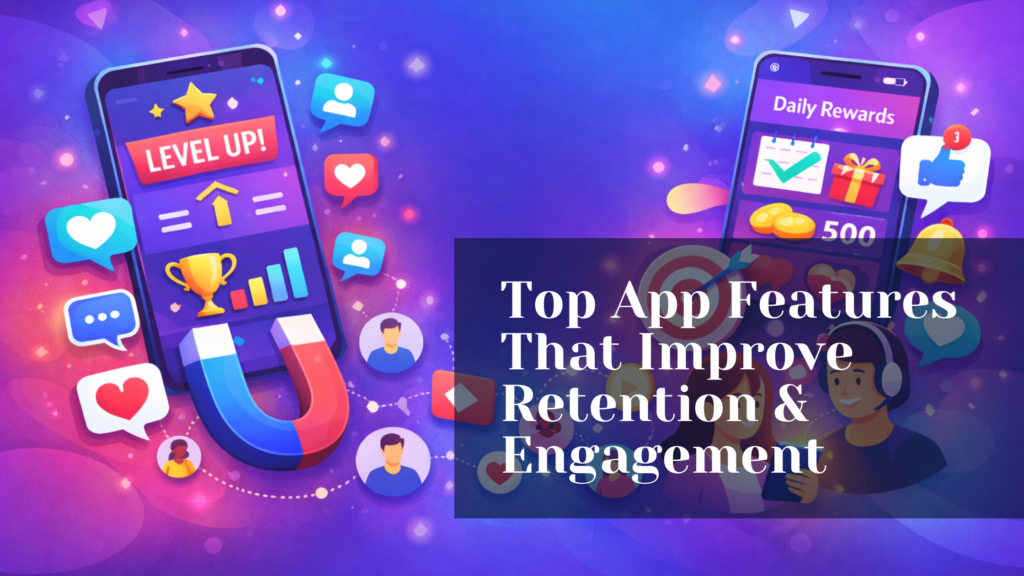
6. Gamification That Encourages Habit Formation
Gamification works – but only when aligned with user goals.
Examples:
- Progress bars
- Achievement badges
- Reward tiers
- Daily streak tracking
Fitness and language-learning apps are classic examples. But gamification isn’t limited to consumer apps.
In healthcare app development, medication adherence apps use streak systems to encourage consistency. In enterprise SaaS, employee training platforms reward module completion.
The psychology is simple: visible progress increases motivation.
7. Continuous Value Through Data Insights
Apps that generate insights outperform apps that simply store data.
Users stay when they receive feedback.
Examples:
- Weekly spending analysis
- Health improvement trends
- Productivity summaries
- Sales performance breakdowns
In enterprise apps, analytics dashboards often drive daily engagement. When executives see actionable insights, logging in becomes necessary.
This is where AI-backed analytics integrated during development by top-tier teams – often among the best app development companies – create long-term differentiation.
8. Seamless Cross-Platform Experience
Retention improves when users can switch devices without friction.
- Start on mobile, continue on web
- Real-time sync
- Consistent UI patterns
- Secure cloud storage
Many businesses underestimate how important cross-platform continuity is.
For example, a B2B SaaS client saw increased engagement after launching a lightweight web dashboard that complemented their mobile app. Users could monitor activity from their desktop during work hours and use mobile on the go.
A capable mobile app development company ensures architecture supports scalability beyond one device.
Mini Case Study: Healthcare App Retention Strategy
A healthcare startup building a chronic condition management app struggled with 30-day retention.
The issue wasn’t feature quantity. It was value clarity.
The solution included:
- Simplified onboarding
- AI-driven symptom pattern recognition
- Weekly progress insights
- Medication reminders with adaptive scheduling
- Doctor communication integration
Within months, active usage increased because the app became part of patients’ daily routines.
Healthcare app development requires a delicate balance between usability, compliance (HIPAA/GDPR), and emotional trust. Retention depends on credibility as much as functionality.
Strategic Insights for Decision-Makers
If you’re a CTO or founder evaluating retention improvements, consider these realities:
- Retention is cheaper than acquisition.
- Feature decisions should be data-backed, not trend-driven.
- Engagement loops must align with business objectives.
- Architecture scalability determines long-term performance.
Building retention features isn’t about copying competitors. It’s about understanding user behavior and building around it.
Common Retention Challenges (And Practical Solutions)
Challenge 1: Feature Overload
Too many features confuse users.
Solution: Prioritize clarity. Remove or simplify underused functionality.
Challenge 2: Poor Analytics Visibility
Without behavior tracking, optimization is guesswork.
Solution: Integrate advanced analytics from the start.
Challenge 3: Security Concerns
Especially in healthcare and fintech apps.
Solution: Work with experienced teams that prioritize encryption, compliance, and secure DevOps practices.
Challenge 4: Scaling Issues
Apps slow down as users grow.
Solution: Invest early in scalable backend infrastructure.
Key Takeaways
- Retention begins with frictionless onboarding and fast value delivery.
- Personalization and intelligent notifications significantly improve engagement.
- Performance optimization directly impacts user trust and longevity.
- Gamification and data insights encourage habit formation.
- Cross-platform continuity increases daily active usage.
FAQs
- What app features improve user retention the most?
Personalized onboarding, smart push notifications, performance optimization, gamification, and actionable data insights consistently improve retention. - How can a mobile app development company help improve engagement?
They design scalable architecture, integrate analytics, optimize performance, and implement personalization strategies that align with business goals. - Why is personalization important in healthcare app development?
It increases trust, improves adherence, and provides contextual health insights while maintaining compliance and data security. - Are push notifications still effective for engagement?
Yes, when behavior-triggered and value-focused. Irrelevant notifications reduce retention. - How do the best app development companies approach retention strategy?
They combine UX research, behavioral analytics, scalable engineering, and iterative testing to refine engagement loops over time.
Conclusion
Retention isn’t accidental. It’s engineered.
The most successful apps – whether consumer-facing platforms or enterprise systems – are built around user behavior, not assumptions. They load quickly, personalize intelligently, provide insights, and continuously deliver value.
For business leaders across the USA, UK, and India, retention strategy should be a core product discussion – not an afterthought.
At Mindaptix, the focus goes beyond launching applications. The goal is to design scalable, secure, and insight-driven digital products that users return to daily. From healthcare app development to enterprise SaaS platforms, long-term engagement starts with smart architecture and thoughtful feature planning.
If retention is your growth lever, it’s time to build with intention.