
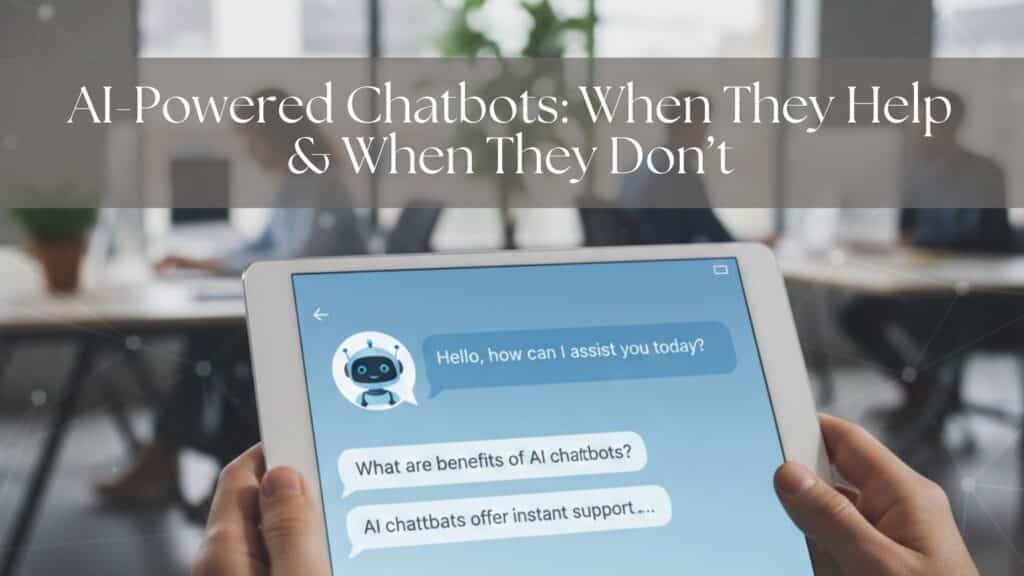
AI-Powered Chatbots: When They Help & When They Don’t
Let’s start with something honest. Most businesses don’t install chatbots because they deeply understand AI. They install them because everyone else is doing it. A competitor adds a chatbot. A SaaS tool suggests automation. A sales consultant says it will reduce costs. So the chatbot goes live. And then one of two things happens: It quietly improves efficiency and nobody complains. Or customers get annoyed and start searching for a phone number. AI-powered chatbots are not good or bad by default. They are useful in specific situations – and completely wrong in others. If you’re running a growing company or working with app programming companies to build digital platforms, this distinction matters more than hype. Let’s talk about reality. When Chatbots Actually Help 1. When Questions Are Predictable If your support inbox is filled with: “Where is my order?” “How do I reset my password?” “What are your pricing plans?” “How do I book a demo?” Then yes – a chatbot can absolutely help. There’s no reason a human should manually respond to the same question 200 times per week. In these cases, automation reduces workload, improves response time, and cuts operational pressure. Many software development outsourcing companies now include chatbot integration as part of broader digital solutions because businesses want efficiency without hiring more staff. And that makes financial sense. 2. When Your Team Is Overwhelmed Early-stage businesses often face this problem: Traffic grows faster than support capacity. Instead of immediately hiring five new support agents, a chatbot can handle the first layer of conversation. It can: Collect basic details Categorize the issue Direct it to the right department That alone can improve internal workflow. But here’s the important part – it works only if there is a human backup system. A chatbot should assist your team, not replace them entirely. 3. When Lead Qualification Matters If you’re an iphone app development company or provide custom tech services, you probably receive a mix of serious and casual inquiries. A few prospects are prepared to move forward immediately. Others are still comparing options and gathering information. And some simply aren’t in a position to spend right now. A chatbot can ask simple filtering questions like: What’s your estimated budget? When do you plan to launch? What platform do you need? This helps your sales team focus on real opportunities. In that case, the chatbot isn’t replacing human conversation – it’s preparing it. When Chatbots Don’t Work Well Now let’s shift to the other side. This is where many businesses get it wrong. 1. When Customers Are Frustrated If someone is angry about a failed payment or delayed service, the last thing they want is automated responses. Nothing damages trust faster than: “I’m sorry, I didn’t understand your request.” When emotion is involved, automation feels cold. In these moments, human empathy matters more than efficiency. 2. When Businesses Try to Cut Costs Too Aggressively Sometimes chatbots are installed for one reason only: reduce staff expenses. That mindset creates problems. If users: Can’t find a real contact option Get stuck in automated loops Can’t escalate their issue They leave. And lost customers cost more than support salaries. The smartest companies treat chatbots as support tools, not gatekeepers. 3. When Integration Is Poor A chatbot that isn’t connected to your backend systems is just a surface-level widget. If it cannot: Access real-time order data Check account details Sync with CRM Log support tickets Then it creates more confusion. This is where proper web application development services become important. The chatbot must connect to your infrastructure, not operate independently. Without that, it feels fake. The Financial Question: Are Chatbots Worth It? This depends on context. Chatbot implementation affects overall app development charges if you’re building a mobile app or platform. Costs include: Setup AI model training Backend integration Ongoing updates Monitoring If your business receives minimal traffic, the investment may not justify itself yet. But if you’re scaling and your support volume is high, automation often pays off within months through efficiency gains. Again, context matters more than trends. Chatbots in Mobile Apps vs Websites There’s a difference here that many businesses overlook. On websites, chatbots mostly answer general inquiries. Inside mobile apps, they often assist with: Account issues In-app navigation Subscription management If you’re working with app programming companies to build mobile solutions, adding chatbot functionality should be a deliberate decision – not a decorative feature. Sometimes a clean UI and clear instructions work better than automation. The Balanced Approach That Works The companies that get this right follow a simple model: Layer 1: Chatbot handles repetitive queries Layer 2: Human support handles complex situations That’s it. Not full automation and manual support. Balance. Many businesses working with software development outsourcing companies adopt this hybrid model because it keeps operational costs stable while maintaining customer satisfaction. What Businesses Should Ask Before Adding a Chatbot Instead of asking, “Should we add AI?” Ask: What exact problem are we solving? Are customers currently waiting too long? Is our support team overloaded? Can we measure performance improvement? Do we have backend systems ready for integration? Technology should solve specific pain points – not just look modern. How This Fits Into a Broader Digital Strategy Chatbots are just one piece of a larger system. They should integrate with: CRM tools Support ticket systems Mobile apps Admin dashboards When built alongside proper web application development services, they become part of an ecosystem instead of an isolated feature. That’s where experienced partners like Mindaptix focus – building structured digital systems instead of scattered tools. Final Thoughts AI-powered chatbots are not magic. They are not a guaranteed growth hack. They help when: Questions are repetitive Volume is high Systems are integrated Humans remain accessible And also they hurt when: Customers are emotional Automation replaces empathy Integration is weak Cost-cutting becomes the main goal The real advantage doesn’t come from having AI. It comes from knowing when to use it. That’s the difference between adopting technology and using it
AI-Powered Chatbots: When They Help & When They Don’t Read More »