
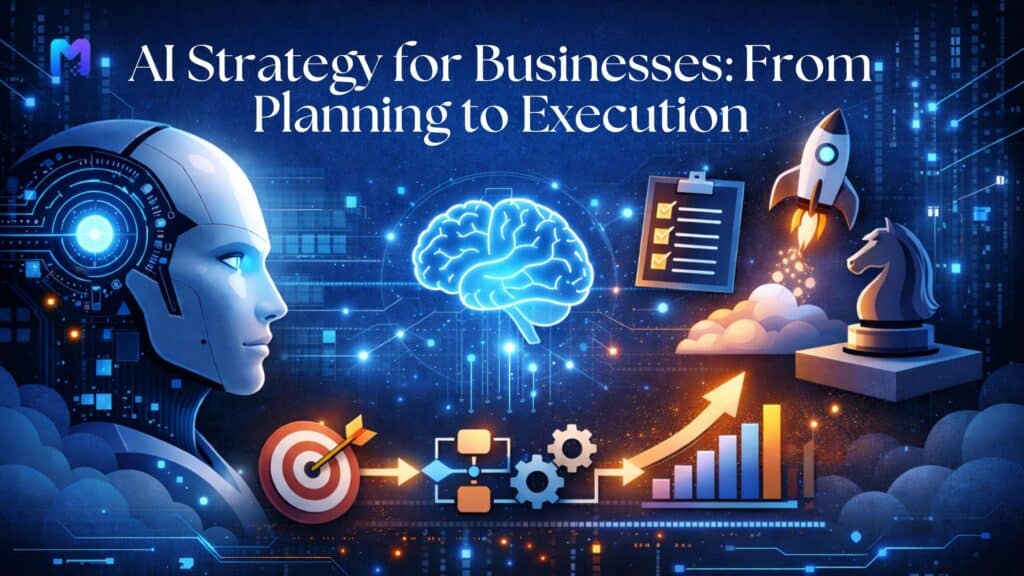
AI Strategy for Businesses: From Planning to Execution
Many businesses across the USA, UK, and India are investing in artificial intelligence-but far fewer are seeing measurable returns. The problem isn’t the technology. It’s the absence of a clear, execution-ready AI strategy. As someone who has worked closely with product teams, CTOs, and founders building scalable digital platforms-from ecommerce mobile app development to healthcare software development-I’ve seen a consistent pattern. Companies rush into tools before defining outcomes. They experiment without aligning AI initiatives to business goals. And they treat AI like a feature rather than a transformation layer across the organization. A successful AI strategy is not about adopting the latest model. It’s about designing a roadmap that connects data, product, operations, and customer experience-then executing it with discipline. Let’s break down how to do it right. 1. Start With Business Outcomes, Not Algorithms AI must solve a business problem. That sounds obvious, yet it’s often overlooked. Before writing a single line of code, leadership teams should answer: What revenue goal are we trying to impact? Which operational inefficiencies are draining cost? Where are customers dropping off? What decisions are currently made on instinct rather than data? For example: AI could improve product recommendations in the creation of mobile e-commerce apps, increasing the average order value. It could reduce manual labor in healthcare software development by automating patient triage procedures. When AI is anchored to measurable KPIs-conversion rate, churn reduction, processing time, fraud detection accuracy-it becomes strategic rather than experimental. 2. Audit Your Data Infrastructure Before Building Anything When AI is connected to measurable KPIs like conversion rate, churn reduction, processing speed, and fraud detection accuracy, it becomes strategic rather than experimental. Before beginning any construction, audit your data infrastructure. The strength of AI depends on the data it uses to learn. Performing a data maturity assessment is one of the initial stages of planning: Where is your data stored? Is it structured and clean? Do systems integrate across departments? Are there governance and compliance measures in place? For companies operating in the US, UK, and India, compliance matters. Healthcare applications, for instance, must align with regulatory frameworks such as HIPAA (US) or GDPR (UK). An AI system trained on fragmented or non-compliant data will create risk rather than value. From a product engineering perspective, your AI roadmap should align with your broader mobile app development and web platform architecture. Integration planning at this stage prevents costly rebuilds later. 3. Choose the Right AI Use Cases for Your Industry Not every AI use case fits every business model. Strategic prioritization is critical. Here are high-impact areas we often implement: Ecommerce Platforms Personalized recommendations Dynamic pricing engines AI-driven inventory forecasting Chatbots with contextual intelligence For ecommerce mobile app development, AI can significantly improve retention by tailoring product feeds in real time. Healthcare & Healthtech Predictive risk scoring Automated claims processing Patient engagement tools Clinical decision support systems Healthcare software development requires special attention to model explainability and compliance. AI must be transparent and auditable. SaaS & Enterprise Applications Workflow automation Predictive analytics dashboards Smart reporting engines Customer churn prediction Companies that position themselves among the best app development companies understand that use case prioritization determines ROI. 4. Build an Execution Framework: Pilot, Validate, Scale An AI strategy without a phased execution plan is just a presentation deck. The most effective structure looks like this: Pilot Select one high-impact, low-risk use case Develop a minimum viable AI model Test with a controlled user group Measure defined KPIs Optimization Refine based on real user behavior Improve model accuracy Strengthen infrastructure Scale Deploy across full user base Integrate with mobile and web systems Monitor continuously In iOS mobile app development company projects, for example, AI features like predictive search or smart notifications are first tested in beta environments before full rollout. Execution discipline separates visionary companies from sustainable ones. 5. Align AI With Product Engineering and App Development AI cannot operate in isolation. It must integrate seamlessly with product design, backend architecture, and user experience. When working with businesses that aim to become the best app development company in USA or expand across international markets, we emphasize: Scalable backend architecture API-driven integrations Modular AI components Performance optimization For mobile app development projects, this means: Ensuring AI features don’t slow app performance Designing intuitive UX around smart features Making recommendations feel helpful, not intrusive A poorly integrated AI feature harms trust. A well-integrated one feels invisible and indispensable. 6. Address the Real Challenges Early No AI strategy is complete without acknowledging risks. Data Privacy & Security Businesses in the US, UK, and India must comply with regional regulations. Strong encryption, access controls, and audit logs are non-negotiable. Talent Gaps AI requires collaboration between data scientists, product managers, and engineers. Many organizations underestimate cross-functional coordination. Unrealistic Expectations AI improves probability and efficiency-it does not guarantee perfection. Setting accurate expectations with stakeholders avoids disillusionment. Technical Debt Legacy systems can block AI integration. Sometimes modernization must precede automation. Companies recognized among the best app development companies approach AI with engineering rigor-not hype. 7. Real-World Scenario: AI in Action Let’s consider a practical example. Case: Ecommerce Brand Expanding to the US and UK A mid-sized ecommerce brand wanted to improve conversion rates across international markets. Their challenge: high traffic, low repeat purchases. Strategy: Implement AI-powered recommendation engine Introduce personalized push notifications Use predictive analytics for inventory management Execution: Pilot on one product category Integrate AI modules into mobile app backend Optimize recommendation logic based on region-specific behavior Result: Improved session time, increased average cart value, and better inventory forecasting. The key wasn’t just AI-it was alignment between data strategy, ecommerce mobile app development, and customer experience design. 8. Measuring AI Success Beyond Vanity Metrics Tracking downloads or impressions isn’t enough. Measure: Revenue per user Customer lifetime value Operational cost reduction Process turnaround time Engagement retention rate In healthcare software development, measurable impact might be reduced administrative workload or improved patient scheduling efficiency. An AI strategy must connect technical performance to financial impact. Key Takeaways AI strategy must
AI Strategy for Businesses: From Planning to Execution Read More »