
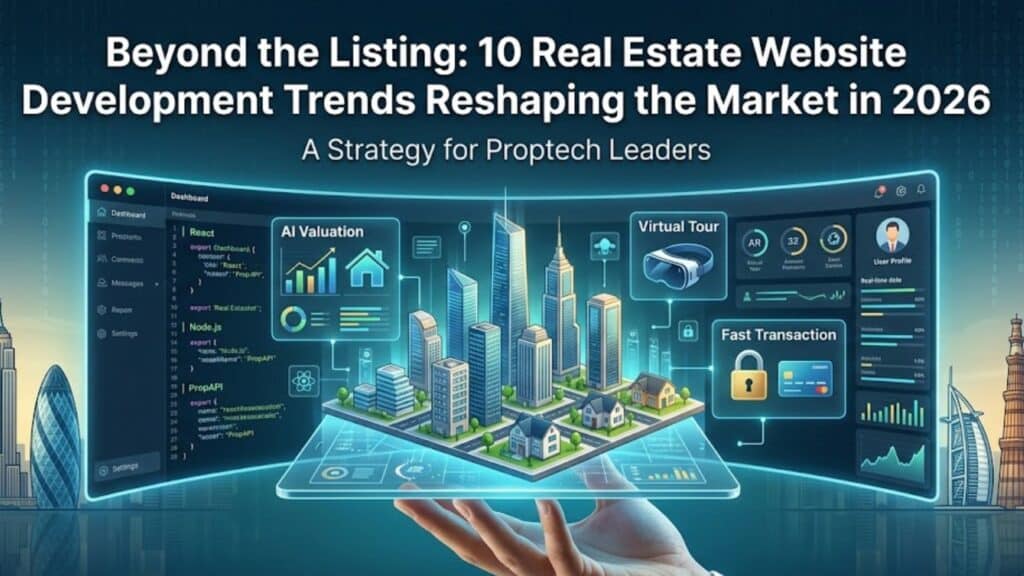
Top 10 Real Estate Website Development Trends in 2026
The real estate industry has officially moved past the “digital brochure” phase. In 2026, a website that simply lists properties and provides a contact form is no longer a tool; it’s a liability. Today’s property buyers—spanning from Gen Z first-timers in Mumbai to institutional investors in London and luxury seekers in New York—demand an ecosystem, not just a search engine. They want speed, predictive intelligence, and a seamless transition from a mobile screen to a physical walkthrough. For CTOs and founders, the challenge isn’t just website development; it’s architecting a scalable platform that integrates fintech, legal tech, and spatial computing. At Mindaptix, we’ve observed a massive shift in how high-growth firms approach their digital presence. Here is how the landscape is shifting and how you can stay ahead. 1. Hyper-Personalization via Predictive Analytics Generic “Recommended for You” sections are dead. In 2026, leading web app development services are focusing on intent-based UI. By leveraging machine learning, platforms now analyze more than just “saved searches.” They look at life events, neighborhood sentiment, and financial readiness. Imagine a user who has been browsing school ratings and proximity to parks. A sophisticated real estate portal won’t just show them three-bedroom houses; it will dynamically reorder the UI to highlight “Family-Centric Features” and provide a “Commute Cost Analysis” specific to their workplace. This level of custom web app development turns a passive browser into a high-intent lead. 2. The Rise of “Phygital” Real Estate: AR & Spatial Integration With the maturation of hardware like Apple Vision Pro and more accessible mobile AR, the “virtual tour” has evolved. We are moving away from static 360-degree photos toward interactive spatial experiences. Modern web app development agencies are now building browsers-based AR tools that allow users to virtually stage a vacant apartment with their own furniture directly through the website. For developers, this means moving toward WebGL and WebXR frameworks to ensure these heavy graphical experiences remain lightweight and responsive on mobile devices. 3. Integrated Fintech & On-Platform Transaction Management The biggest friction point in real estate is the “offline” gap—the moment a user leaves the site to talk to a bank or a lawyer. In 2026, the trend is to close that loop. Successful saas application development services are integrating mortgage pre-approval APIs, escrow management, and digital identity verification (KYC) directly into the property portal. By transforming a website into a transaction engine, you increase user retention and capture valuable data that was previously lost to third-party institutions. 4. AI-Driven Automated Valuations (AVM 2.0) Zestimates were the first generation. The next generation of valuation tools uses real-time economic data, satellite imagery (to assess roof quality or neighborhood green cover), and even hyper-local social sentiment. For a real estate web development company, the goal is to build trust through transparency. Instead of giving one “magic number,” 2026 websites provide a “Valuation Range” with clear data points explaining why a property is priced that way. This level of detail is what wins over the sophisticated modern investor. 5. Micro-Neighborhood Data & “Vibe” Mapping Data is no longer just about square footage and price. Buyers want to know the “soul” of a location. We are seeing a surge in demand for custom API integrations that pull data on: Local coffee shop ratings and “work-from-home” friendliness. Noise pollution levels at different times of the day. EV charging station density. Hyper-local crime trends vs. national averages. Developing these features requires a robust backend architecture capable of processing massive datasets without slowing down the frontend—a core focus of high-end web app development. 6. Sustainable & “Green” Property Metrics Sustainability is moving from a “nice-to-have” to a regulatory requirement in the UK and parts of the USA. Real estate platforms in 2026 are prioritizing “Carbon Footprint” scores and “Energy Efficiency” ratings. Your website should allow users to filter properties based on solar readiness, insulation quality, or LEED certification. Building these features requires a deep understanding of regional data standards, making the choice of a knowledgeable web app development agency crucial. 7. Fractional Ownership and Blockchain Ledgers The barrier to entry for real estate investment is lowering. Many startups are now requesting saas application development services that support fractional ownership. This involves creating secure dashboards where multiple investors can track their percentage of a property, receive automated rental dividends, and trade their “shares.” While the buzz around NFTs has cooled, the underlying ledger technology is being used for clean, immutable title deed records and transparent transaction histories. 8. Voice-First Search and Conversational UI In the USA and India, voice search is exploding. “Find me a 2-bedroom apartment under $3,000 near a Metro station” is a complex query for traditional search bars. Modern website development now incorporates Natural Language Processing (NLP) to handle these long-tail, conversational queries. Instead of a maze of filters, users get a chat-like interface that understands context, making the search process feel more like talking to a local expert than a database. Real-World Scenario: The “One-Click” Relocation A tech professional in London is relocated to New York. Instead of visiting ten different sites, they use a modern platform built with an integrated SaaS approach. The site recognizes their LinkedIn profile (with permission), suggests neighborhoods based on their office location, provides a virtual “staged” tour of three apartments, runs a preliminary credit check via an integrated API, and allows them to sign a digital lease—all within one web application. This isn’t science fiction; it’s the standard being built today. Overcoming Challenges in 2026 Web Development Challenge Strategic Solution Data Privacy (GDPR/CCPA) Implementing “Privacy by Design” and zero-knowledge proofs for user financial data. Platform Speed Using Edge Computing and Server-Side Rendering (SSR) to ensure heavy AR features don’t lag. Legacy Integration Building “Headless” architectures that allow modern frontends to talk to old MLS databases. Key Takeaways for Business Leaders Experience Over Information: Don’t just show data; tell a story about the lifestyle the property offers. Close the Loop: Integrate fintech and legal tools to keep the user on your platform until the
Top 10 Real Estate Website Development Trends in 2026 Read More »