
MindAptix | AI-Powered Development Agency

Uncover proof of MindAptix impact across 3000 + digital deliveries for 35+ industries. EXPLORE NOW! Uncover proof of MindAptix impact across 3000+ digital deliveries for 35+ industries. EXPLORE NOW!
Uncover proof of MindAptix impact across 3000+ digital deliveries for 35+ industries. EXPLORE NOW! Uncover proof of MindAptix impact across 3000+ digital deliveries for 35+ industries. EXPLORE NOW!

March 2026

AI Strategy

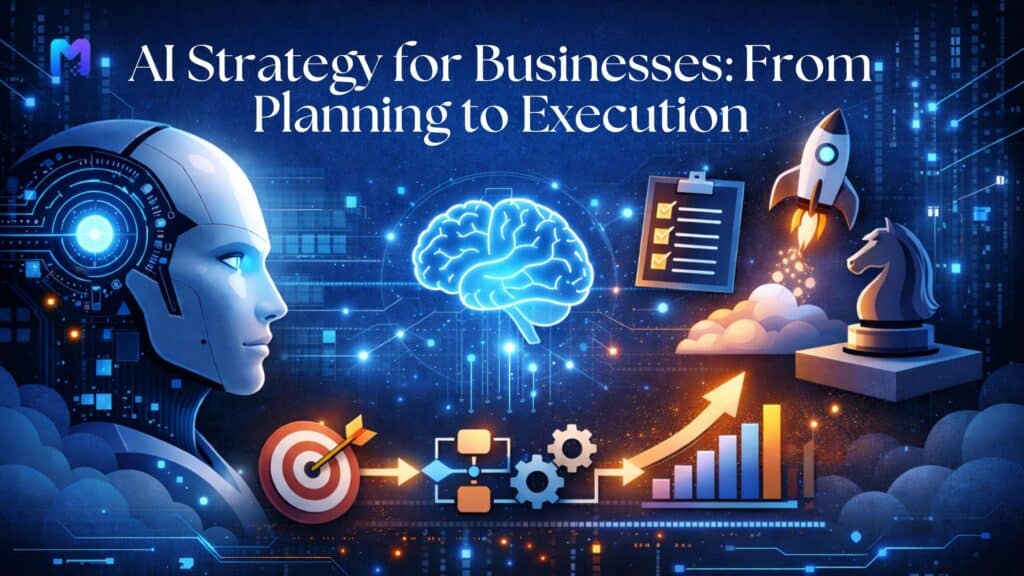
AI Strategy for Businesses: From Planning to Execution

Many businesses across the USA, UK, and India are investing in artificial intelligence-but far fewer are seeing measurable returns. The problem isn’t the technology. It’s the absence of a clear, execution-ready AI strategy. As someone who has worked closely with product teams, CTOs, and founders building scalable digital platforms-from ecommerce mobile app development to healthcare software development-I’ve seen a consistent pattern. Companies rush into tools before defining outcomes. They experiment without aligning AI initiatives to business goals. And they treat AI like a feature rather than a transformation layer across the organization. A successful AI strategy is not about adopting the latest model. It’s about designing a roadmap that connects data, product, operations, and customer experience-then executing it with discipline. Let’s break down how to do it right. 1. Start With Business Outcomes, Not Algorithms AI must solve a business problem. That sounds obvious, yet it’s often overlooked. Before writing a single line of code, leadership teams should answer: What revenue goal are we trying to impact? Which operational inefficiencies are draining cost? Where are customers dropping off? What decisions are currently made on instinct rather than data? For example: AI could improve product recommendations in the creation of mobile e-commerce apps, increasing the average order value. It could reduce manual labor in healthcare software development by automating patient triage procedures. When AI is anchored to measurable KPIs-conversion rate, churn reduction, processing time, fraud detection accuracy-it becomes strategic rather than experimental. 2. Audit Your Data Infrastructure Before Building Anything When AI is connected to measurable KPIs like conversion rate, churn reduction, processing speed, and fraud detection accuracy, it becomes strategic rather than experimental. Before beginning any construction, audit your data infrastructure. The strength of AI depends on the data it uses to learn. Performing a data maturity assessment is one of the initial stages of planning: Where is your data stored? Is it structured and clean? Do systems integrate across departments? Are there governance and compliance measures in place? For companies operating in the US, UK, and India, compliance matters. Healthcare applications, for instance, must align with regulatory frameworks such as HIPAA (US) or GDPR (UK). An AI system trained on fragmented or non-compliant data will create risk rather than value. From a product engineering perspective, your AI roadmap should align with your broader mobile app development and web platform architecture. Integration planning at this stage prevents costly rebuilds later. 3. Choose the Right AI Use Cases for Your Industry Not every AI use case fits every business model. Strategic prioritization is critical. Here are high-impact areas we often implement: Ecommerce Platforms Personalized recommendations Dynamic pricing engines AI-driven inventory forecasting Chatbots with contextual intelligence For ecommerce mobile app development, AI can significantly improve retention by tailoring product feeds in real time. Healthcare & Healthtech Predictive risk scoring Automated claims processing Patient engagement tools Clinical decision support systems Healthcare software development requires special attention to model explainability and compliance. AI must be transparent and auditable. SaaS & Enterprise Applications Workflow automation Predictive analytics dashboards Smart reporting engines Customer churn prediction Companies that position themselves among the best app development companies understand that use case prioritization determines ROI. 4. Build an Execution Framework: Pilot, Validate, Scale An AI strategy without a phased execution plan is just a presentation deck. The most effective structure looks like this: Pilot Select one high-impact, low-risk use case Develop a minimum viable AI model Test with a controlled user group Measure defined KPIs Optimization Refine based on real user behavior Improve model accuracy Strengthen infrastructure Scale Deploy across full user base Integrate with mobile and web systems Monitor continuously In iOS mobile app development company projects, for example, AI features like predictive search or smart notifications are first tested in beta environments before full rollout. Execution discipline separates visionary companies from sustainable ones. 5. Align AI With Product Engineering and App Development AI cannot operate in isolation. It must integrate seamlessly with product design, backend architecture, and user experience. When working with businesses that aim to become the best app development company in USA or expand across international markets, we emphasize: Scalable backend architecture API-driven integrations Modular AI components Performance optimization For mobile app development projects, this means: Ensuring AI features don’t slow app performance Designing intuitive UX around smart features Making recommendations feel helpful, not intrusive A poorly integrated AI feature harms trust. A well-integrated one feels invisible and indispensable. 6. Address the Real Challenges Early No AI strategy is complete without acknowledging risks. Data Privacy & Security Businesses in the US, UK, and India must comply with regional regulations. Strong encryption, access controls, and audit logs are non-negotiable. Talent Gaps AI requires collaboration between data scientists, product managers, and engineers. Many organizations underestimate cross-functional coordination. Unrealistic Expectations AI improves probability and efficiency-it does not guarantee perfection. Setting accurate expectations with stakeholders avoids disillusionment. Technical Debt Legacy systems can block AI integration. Sometimes modernization must precede automation. Companies recognized among the best app development companies approach AI with engineering rigor-not hype. 7. Real-World Scenario: AI in Action Let’s consider a practical example. Case: Ecommerce Brand Expanding to the US and UK A mid-sized ecommerce brand wanted to improve conversion rates across international markets. Their challenge: high traffic, low repeat purchases. Strategy: Implement AI-powered recommendation engine Introduce personalized push notifications Use predictive analytics for inventory management Execution: Pilot on one product category Integrate AI modules into mobile app backend Optimize recommendation logic based on region-specific behavior Result: Improved session time, increased average cart value, and better inventory forecasting. The key wasn’t just AI-it was alignment between data strategy, ecommerce mobile app development, and customer experience design. 8. Measuring AI Success Beyond Vanity Metrics Tracking downloads or impressions isn’t enough. Measure: Revenue per user Customer lifetime value Operational cost reduction Process turnaround time Engagement retention rate In healthcare software development, measurable impact might be reduced administrative workload or improved patient scheduling efficiency. An AI strategy must connect technical performance to financial impact. Key Takeaways AI strategy must

AI Strategy for Businesses: From Planning to Execution Read More »
AI Analytics

How AI Analytics Helps Businesses Make Better Decisions

Running a business today feels very different than it did even five years ago. Markets move faster. Customer expectations change overnight. Trends appear, explode, and disappear within weeks. In this environment, making decisions based purely on instinct is risky. That’s why more companies are turning to AI analytics – not as a buzzword, but as a practical decision-making partner. AI analytics doesn’t replace leadership. It strengthens it. It gives founders, managers, and executives the clarity they need to move forward with confidence instead of uncertainty. When implemented properly through reliable ai software development services, AI becomes part of your company’s strategic foundation – not just another tech upgrade. Let’s explore how AI analytics actually helps businesses make better decisions – in real, human terms. The Real Problem: Too Much Data, Not Enough Clarity Most businesses already have data. Sales reports Customer feedback Website analytics Marketing performance dashboards CRM records But here’s the challenge: data alone doesn’t create direction. Many leadership teams spend hours reviewing spreadsheets and dashboards, only to walk away asking, “Okay, but what should we actually do?” AI analytics bridges that gap. It doesn’t just present numbers. It identifies patterns, predicts outcomes, and recommends next steps. Instead of asking, “What happened last quarter?” You start asking, “What’s likely to happen next – and how do we prepare?” That shift alone changes the way businesses operate. From Reactive Decisions to Predictive Strategy Traditional analytics looks backward. AI analytics looks forward. For example: It can identify which customers are likely to stop buying soon. It can forecast demand spikes before they happen. It can predict which marketing campaign will outperform others. When integrated into systems through web application development services, these predictive insights become part of daily operations. Decision-makers don’t have to request reports – they receive intelligent alerts in real time. That means fewer surprises and more control. Smarter Customer Understanding Every business wants to understand its customers better. But surveys and feedback forms only reveal part of the story. AI analytics goes deeper. It analyzes behavior patterns – what users click, how long they stay, what they ignore, when they leave. It connects these signals to uncover hidden insights about preferences, buying habits, and engagement triggers. For businesses investing in hybrid mobile app development, AI can be embedded directly into apps to personalize experiences in real time. For example: Recommending products based on browsing history Adjusting content based on engagement patterns Sending offers when users are most likely to convert This level of personalization doesn’t just increase sales. It builds stronger relationships. And stronger relationships drive long-term growth. Making Marketing Budgets Work Harder Marketing decisions are often based on trial and error. Teams test campaigns, wait for results, and adjust. AI analytics shortens that cycle dramatically. Instead of waiting weeks for performance data, AI systems analyze campaigns continuously. They detect which audience segments respond best, which messaging resonates, and where ad spend is being wasted. When built into your ecosystem through scalable software development services, these insights become automatic. Marketing teams can shift budgets quickly, optimize targeting, and improve ROI without guesswork. The result? Smarter spending and better returns. Improving Operational Efficiency AI analytics isn’t just about customers and revenue. It also improves internal operations. Through custom enterprise software development, AI can be integrated into business systems to: Identify workflow bottlenecks Predict supply chain disruptions Optimize staffing schedules Reduce inventory waste For example, AI can analyze historical purchasing data and forecast demand more accurately. That prevents overstocking or stockouts – both of which impact profitability. Small operational improvements may seem minor individually. But together, they create major efficiency gains. Better Mobile Decision-Making for Leaders Executives and managers are rarely sitting at one desk all day. Decisions happen during meetings, travel, and client interactions. This is where ios app development services and hybrid mobile solutions become powerful. Imagine opening your company’s mobile dashboard and seeing: AI-generated sales forecasts Alerts about unusual activity Customer churn risk predictions Real-time performance summaries No delays. No waiting for emailed reports. Just actionable insight when you need it. Mobile-accessible AI analytics allows leaders to act quickly and confidently. Supporting Startups With Smarter Growth Startups face constant uncertainty. They have limited resources, evolving product ideas, and aggressive growth targets. Every decision matters. AI analytics helps startups: Validate product-market fit Understand early user behavior Forecast revenue scenarios Identify high-growth channels Instead of scaling blindly, startups can scale strategically. By integrating AI early through flexible ai software development services, startups build intelligence into their product from the beginning – not as an afterthought. Enterprise-Level Strategic Advantage Large enterprises often struggle with data overload. Different departments operate in silos. Insights don’t always connect. With proper custom enterprise software development, AI analytics can unify data from: Sales systems Marketing platforms Customer support channels Financial software When these systems communicate, AI identifies patterns across the entire organization. For example, it may discover that certain support issues directly impact sales performance – something that might not be obvious when teams operate separately. AI turns disconnected information into strategic alignment. Reducing Human Bias in Decision-Making We all have biases. It’s human nature. We may favor familiar strategies, rely on past success and underestimate emerging risks. AI analytics doesn’t have emotional bias. It evaluates patterns objectively. That doesn’t mean leaders stop using judgment. It means decisions are supported by evidence, not assumptions. This combination – human experience plus AI insight – creates stronger outcomes. Real-Time Risk Detection Risk management is another area where AI shines. AI systems can detect: Unusual transaction activity Fraud indicators Performance anomalies Sudden drops in engagement Instead of discovering problems weeks later, businesses receive alerts immediately. That speed protects revenue, brand reputation, and customer trust. When integrated through reliable web application development services, AI-powered monitoring becomes a continuous safety net. Building an AI-Driven Business Culture Technology alone doesn’t create transformation. To truly benefit from AI analytics, businesses must: Encourage data-driven decision-making Invest in clean and organized data systems Continuously refine AI models Align AI insights with clear business

How AI Analytics Helps Businesses Make Better Decisions Read More »

Product Development

Product Development Lifecycle: From Idea to Market

– A Deep Dive With Real-World Relevance Nowadays, it takes more than simply code to create a successful digital product. It involves following a planned path, from discovering a compelling concept to providing a ready-to-sell solution that pleases customers and propels company expansion. We refer to this process as the Product Development Lifecycle (PDLC), a strategic road map that links strategy and implementation. In this blog, we’ll break down this lifecycle step by step, humanize the process for founders, product managers, and tech enthusiasts, and show how it ties directly into modern digital services like business mobile app development, web app development services, software development for startups, healthcare software development services, and ecommerce app development – especially as delivered by leading digital innovators like MindAptix. Ideation & Discovery – Where Ideas Spark Life Every innovation begins with a thought – that “what if?” moment. Ideation isn’t just brainstorming; it’s identifying real human problems worth solving. Successful products are born where genuine user pain points meet insights from research and empathy. At this stage, teams answer questions like: What challenge are we addressing? Who experiences this challenge and why? What existing solutions fall short? This phase involves market research, competitor analysis, and user interviews to validate assumptions before any development begins. Whether it’s envisioning a mobile app to streamline logistics or a healthcare tool that empowers patients, solid ideation anchors the product in reality. Tools like user personas, customer journey maps, and emerging tech trend analysis help validate an idea before committing resources. This initial clarity saves time and money down the road. Concept Validation & Feasibility – Building Confidence Early Once an idea feels promising, the next step is to validate it. This means gauging whether: The market truly needs the product. Users would pay for it. It can be built with current technology and budget constraints. In digital product development – from software development for startups to healthcare software development services – this phase often includes early prototyping, wireframes, and feedback from potential users. With services like those offered by MindAptix, teams collaborate to refine the concept, visualize features through mockups, and create early MVP plans that shape the direction of business mobile app development or ecommerce app development. This step also involves technical feasibility analysis (can we build what we imagine?) and business viability analysis (will it grow profitably?), setting the foundation for the design and implementation phases. Design & Prototyping – Translating Ideas Into Reality Good design isn’t decoration – it’s a strategic blueprint for how users feel and interact with a product. During this stage: UX designers map user flows. UI designers bring screens to life. Teams create interactive prototypes to test real user behavior. With tools like Figma or Adobe XD, prototypes become functional enough for users to explore and give feedback before development begins. Design is particularly critical in web app development services and mobile app projects, where usability directly impacts conversion, retention, and customer satisfaction. Companies like MindAptix emphasize mobile-first design strategies and UX optimization to ensure products not only work but delight customers across platforms. Development – Bringing Code to Life This is where the product takes tangible form. Developers transform designs and prototypes into real, functional code. This phase includes: Backend architecture and database structuring API development and integration Frontend implementation for web and mobile interfaces Depending on the scope, development can follow agile, iterative, or incremental approaches, allowing frequent feedback and refinement. For example: Business mobile app development involves native or cross-platform coding for iOS and Android. Web app development requires responsive front-end interfaces and scalable backend services. Healthcare software development services often need compliance, secure data handling, and performance optimization. A strong development process ensures the software is scalable, modular, and maintainable – qualities essential for products that grow with user expectations. Testing & Quality Assurance – Confidence in Every Release No product should reach users without rigorous testing. At this phase, quality assurance (QA) ensures the product works as expected across devices, platforms, and user scenarios. Teams perform: Functional testing Usability testing Load and performance tests Security validation (especially important in healthcare and ecommerce) Thorough QA prevents costly mistakes post-launch and reinforces trust with users. An integrated testing process – whether automated or manual – helps digital solutions run seamlessly, improving user retention and brand credibility. Launch & Deployment – Entering the Market After months of planning, designing, building, and testing, it’s time to bring the product to life in the real world. Deploying software involves: Publishing mobile apps to stores (App Store, Google Play) Deploying web applications to cloud platforms Configuring security, analytics, and monitoring tools But launch isn’t the finish line – it’s a new beginning. A smart launch strategy includes: Marketing campaigns Analytics tracking Early user support and onboarding This phase also kickstarts the product’s evolution, guided by data and feedback. Post-Launch Optimization & Growth – Learn, Iterate, Improve Once the product is live, the work continues. The first users offer invaluable feedback – what works, what doesn’t, and what’s missing. Successful products thrive when teams: Monitor key performance metrics Analyze user behavior Release regular updates Optimize for performance and experience For startups and enterprises alike, this means evolving the product to stay relevant, competitive, and valuable to users. Agile teams embrace this iteration loop – enhancing features, fixing bugs, and innovating based on real customer insights. Why This Lifecycle Matters – In Plain Terms Across industries and technologies, the PDLC: Reduces risk by validating ideas early. Improves alignment between business goals and user needs. Accelerates time to market with structured processes. Enhances product quality through continuous testing and improvements. Whether you’re building a simple MVP or a full-featured platform, each step ensures your product is purposeful, usable, and ready to grow. How Companies Like MindAptix Translate this into Action Today’s digital market demands versatility. Leaders in digital product delivery like MindAptix take this lifecycle and operationalize it with real engineering expertise: End-to-end business mobile app development and web app development services tailored to

Product Development Lifecycle: From Idea to Market Read More »